PUBLICATIONS
PUBLICATIONS
PUBLICATIONS
Kingfisher's consultants have translated their experience and insights in the areas of strategy, (digital) business transformation, programme management and more into pragmatic books and guides that enable you to achieve concrete impact and bring about integral change.
OUR BOOKS
OUR BOOKS
OUR BOOKS
We kapitaliseren onze kennis en ervaring in frameworks en praktische leidraden, geven opleiding & training en coachen managers en specialisten uit ons vakgebied. Onze gerenommeerde visie en aanpakken, zoals het Business Transformatie Canvas, geven concrete handvatten om inzicht en overzicht te creëren. Zo helpen we zelfs de meest complexe organisatie succesvol te transformeren.
AUTHORS: Marc Beijen, Ruben Heetebrij & Roos Tigchelaar
PUBLISHER: Van Haren Publishing
ISBN: 9789401813693 (Dutch)
BUSINESS TRANSFORMATION CANVAS
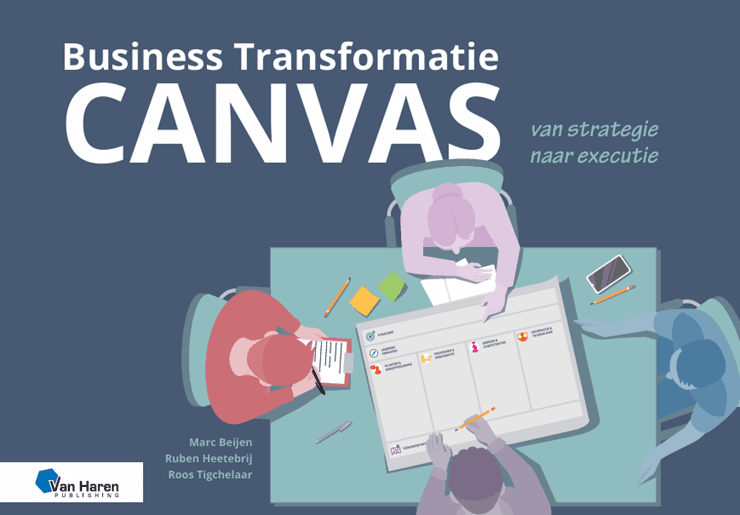
Organisations are often perfectly capable of drawing up a strategy. Countless books have been written on the subject and methods developed. But the question of how to actually execute this strategy proves to be much more difficult. A strategy without a clear execution plan is often nothing more than hot air.
Discover how to execute your strategy and bring about successful change with the Business Transformation Canvas.
‘An indispensable tool for successfully realising business strategies and ambitions.’
‘The Business Transformation Canvas provides exactly the guidance you need: it helps you organise your ambitions and initiatives, create coherence and make sharp choices.’
‘Marc describes this in an accessible and concrete way, without woolly language but with immediately applicable tools.'
'This book is a valuable guide that connects theory and practice in an inspiring way.’
AUTHOR: Marc Beijen
PUBLISHER: Van Haren Publishing
ISBN: 9789401807739 (English)
SUCCESSFUL
DIGITAL TRANSFORMATION
Successful Digital Transformation is a guide and reference work for anyone involved in the management or substantive implementation of digital transformation. The book is primarily aimed at managers and directors at the strategic and tactical level, but also at anyone involved in achieving digital transformation: business developers, marketers, line management, consultants, analysts, IT professionals, architects, and programme and change managers.
This book emphasises that there is a considerable need for organisations to tackle digital transformation in a bold and ambitious manner. The fear of making mistakes must be put aside; only by doing and learning can speed be achieved. With this book, Marc Beijen makes the complexity associated with digital transformations manageable again. By introducing structure, unravelling issues and considering them holistically, in context. By distinguishing between main and side issues, applying the 80/20 rule and setting clear priorities. The core message is that organisations need to get to work if they want to continue to play a leading role in their market.
AUTHORS: René Hombergen, David de Graaf e.a.
PUBLISHER: Scriptum
ISBN: 9789055948765 (Dutch)
PROGRAMME MANAGEMENT SELECTION MENU
The Programme Management Selection Menu describes the six most important visions in the Netherlands in the field of programme management. Programme management is the management of the relationship between projects and organisational change in order to achieve one (or more) strategic objectives.
Many colleagues and clients are unaware that there are multiple visions on programme management and that alternatives are therefore available. The book provides insight into the different visions, how these visions came about and the strengths of each vision. The six visions are also compared with each other.
When designing large-scale changes, this book offers guidance in choosing a particular programme management vision and the associated methodology.
We are proud that our vision on programme management – integral programme management – has been included in this book as one of the six visions on programme management in the Netherlands. The IPM vision was published in 2008 by David de Graaf at Academic Services.
AUTHORS: Marc Beijen, Eric Broos & Etienne Lucas
PUBLISHER: Boom
ISBN: 9789014074276 (Dutch)
STRATEGIC USE OF
ICT
There is a growing awareness in the business community and government that information and communication technology has become an indispensable tool.
ICT is no longer the preserve of automation specialists, but now also requires the full attention and guidance of managers.
How can they structurally and fundamentally improve the performance of their organisations through the optimal use of ICT?
The authors describe innovative visions and concepts for doing business with ICT and provide guidance on how to implement and manage them.
Well-known and proven methods and techniques are combined in a practical framework.The principles of this framework – every situation requires a tailor-made approach and the use of ICT is a business issue, not an ICT issue, and therefore belongs with managers – are applicable in both large and small organisations.
AUTHOR: David de Graaf
PUBLISHER: Academic service
ISBN: 9789012117791 (Dutch)
INTEGRATED PROGRAMME MANAGEMENT
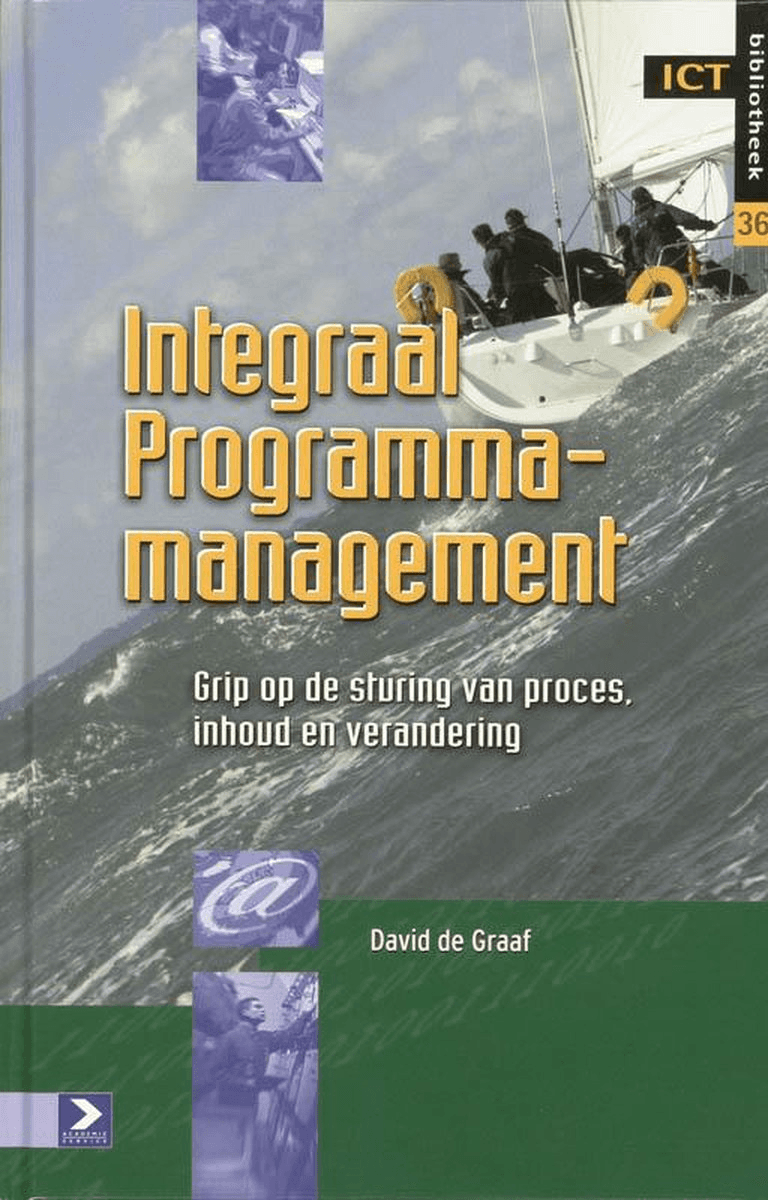
Control over the process, content and change. David de Graaf describes in practical terms how an organisation's strategy and business objectives can be achieved through the use of programme management to control projects.
He outlines the relationship with project portfolio management, (multi)project management and business and information planning. Not only does he discuss the administrative side of programme management, but also the approach to achieving substantive control of programmes through the use of architecture.
In addition to the rational and instrumental side of programme management, explicit attention is given to the change management or human aspects that come into play in large-scale changes.
This book – which includes many concrete practical examples – is written for anyone who is directly or indirectly involved in the programme management of business projects with a large ICT component.
AUTHORS: Marc Beijen, Eric Broos & Jan Herbrink
PUBLISHER: Ten Hagen Stam
ISBN: 9789026718977 (Dutch)
INFORMATION PLANNING AND CONTROL.
How can you structurally and fundamentally improve your organisation's performance through the optimal use of ICT?
This is the issue you are facing, and this is what Information Planning and Control is all about. It describes innovative visions and concepts for the use of ICT and offers guidance on how to implement and manage them.
Well-known and proven methods and techniques are combined in a single clear and practical framework.
The principles of this framework are applicable in both large and small organisations.
The concepts, guidelines, methods and techniques described are of interest to anyone in the business community and government who is involved in improving their organisation through the use of ICT: (line) managers, marketers, controllers, personnel organisation and information advisors (internal and external), information managers and ICT professionals.
AUTHORS: Marc Beijen, Ruben Heetebrij & Roos Tigchelaar
PUBLISHER: Van Haren Publishing
ISBN: 9789401813693 (Dutch)
BUSINESS TRANSFORMATION CANVAS
Organisations are often perfectly capable of drawing up a strategy. Countless books have been written on the subject and methods developed. But the question of how to actually execute this strategy proves to be much more difficult. A strategy without a clear execution plan is often nothing more than hot air.
Discover how to execute your strategy and bring about successful change with the Business Transformation Canvas.
‘An indispensable tool for successfully realising business strategies and ambitions.’
‘The Business Transformation Canvas provides exactly the guidance you need: it helps you organise your ambitions and initiatives, create coherence and make sharp choices.’
‘Marc describes this in an accessible and concrete way, without woolly language but with immediately applicable tools.'
'This book is a valuable guide that connects theory and practice in an inspiring way.’
AUTHOR: Marc Beijen
PUBLISHER: Van Haren Publishing
ISBN: 9789401807739 (English)
SUCCESSFUL
DIGITAL TRANSFORMATION
Successful Digital Transformation is a guide and reference work for anyone involved in the management or substantive implementation of digital transformation. The book is primarily aimed at managers and directors at the strategic and tactical level, but also at anyone involved in achieving digital transformation: business developers, marketers, line management, consultants, analysts, IT professionals, architects, and programme and change managers.
This book emphasises that there is a considerable need for organisations to tackle digital transformation in a bold and ambitious manner. The fear of making mistakes must be put aside; only by doing and learning can speed be achieved. With this book, Marc Beijen makes the complexity associated with digital transformations manageable again. By introducing structure, unravelling issues and considering them holistically, in context. By distinguishing between main and side issues, applying the 80/20 rule and setting clear priorities. The core message is that organisations need to get to work if they want to continue to play a leading role in their market.
AUTHORS: René Hombergen, David de Graaf e.a.
PUBLISHER: Scriptum
ISBN: 9789055948765 (Dutch)
PROGRAMME MANAGEMENT SELECTION MENU
The Programme Management Selection Menu describes the six most important visions in the Netherlands in the field of programme management. Programme management is the management of the relationship between projects and organisational change in order to achieve one (or more) strategic objectives.
Many colleagues and clients are unaware that there are multiple visions on programme management and that alternatives are therefore available. The book provides insight into the different visions, how these visions came about and the strengths of each vision. The six visions are also compared with each other.
When designing large-scale changes, this book offers guidance in choosing a particular programme management vision and the associated methodology.
We are proud that our vision on programme management – integral programme management – has been included in this book as one of the six visions on programme management in the Netherlands. The IPM vision was published in 2008 by David de Graaf at Academic Services.
AUTHORS: Marc Beijen, Eric Broos & Etienne Lucas
PUBLISHER: Boom
ISBN: 9789014074276 (Dutch)
STRATEGIC USE OF
ICT
There is a growing awareness in the business community and government that information and communication technology has become an indispensable tool.
ICT is no longer the preserve of automation specialists, but now also requires the full attention and guidance of managers.
How can they structurally and fundamentally improve the performance of their organisations through the optimal use of ICT?
The authors describe innovative visions and concepts for doing business with ICT and provide guidance on how to implement and manage them.
Well-known and proven methods and techniques are combined in a practical framework.The principles of this framework – every situation requires a tailor-made approach and the use of ICT is a business issue, not an ICT issue, and therefore belongs with managers – are applicable in both large and small organisations.
AUTHOR: David de Graaf
PUBLISHER: Academic service
ISBN: 9789012117791 (Dutch)
INTEGRATED PROGRAMME MANAGEMENT
Control over the process, content and change. David de Graaf describes in practical terms how an organisation's strategy and business objectives can be achieved through the use of programme management to control projects.
He outlines the relationship with project portfolio management, (multi)project management and business and information planning. Not only does he discuss the administrative side of programme management, but also the approach to achieving substantive control of programmes through the use of architecture.
In addition to the rational and instrumental side of programme management, explicit attention is given to the change management or human aspects that come into play in large-scale changes.
This book – which includes many concrete practical examples – is written for anyone who is directly or indirectly involved in the programme management of business projects with a large ICT component.
AUTHORS: Marc Beijen, Eric Broos & Jan Herbrink
PUBLISHER: Ten Hagen Stam
ISBN: 9789026718977 (Dutch)
INFORMATION PLANNING AND CONTROL.
How can you structurally and fundamentally improve your organisation's performance through the optimal use of ICT?
This is the issue you are facing, and this is what Information Planning and Control is all about. It describes innovative visions and concepts for the use of ICT and offers guidance on how to implement and manage them.
Well-known and proven methods and techniques are combined in a single clear and practical framework.
The principles of this framework are applicable in both large and small organisations.
The concepts, guidelines, methods and techniques described are of interest to anyone in the business community and government who is involved in improving their organisation through the use of ICT: (line) managers, marketers, controllers, personnel organisation and information advisors (internal and external), information managers and ICT professionals.
AUTHORS: Marc Beijen, Ruben Heetebrij & Roos Tigchelaar
PUBLISHER: Van Haren Publishing
ISBN: 9789401813693 (Dutch)
BUSINESS TRANSFORMATION CANVAS
Organisations are often perfectly capable of drawing up a strategy. Countless books have been written on the subject and methods developed. But the question of how to actually execute this strategy proves to be much more difficult. A strategy without a clear execution plan is often nothing more than hot air.
Discover how to execute your strategy and bring about successful change with the Business Transformation Canvas.
‘An indispensable tool for successfully realising business strategies and ambitions.’
‘The Business Transformation Canvas provides exactly the guidance you need: it helps you organise your ambitions and initiatives, create coherence and make sharp choices.’
‘Marc describes this in an accessible and concrete way, without woolly language but with immediately applicable tools.'
'This book is a valuable guide that connects theory and practice in an inspiring way.’
AUTHOR: Marc Beijen
PUBLISHER: Van Haren Publishing
ISBN: 9789401807739 (English)
SUCCESSFUL
DIGITAL TRANSFORMATION
Successful Digital Transformation is a guide and reference work for anyone involved in the management or substantive implementation of digital transformation. The book is primarily aimed at managers and directors at the strategic and tactical level, but also at anyone involved in achieving digital transformation: business developers, marketers, line management, consultants, analysts, IT professionals, architects, and programme and change managers.
This book emphasises that there is a considerable need for organisations to tackle digital transformation in a bold and ambitious manner. The fear of making mistakes must be put aside; only by doing and learning can speed be achieved. With this book, Marc Beijen makes the complexity associated with digital transformations manageable again. By introducing structure, unravelling issues and considering them holistically, in context. By distinguishing between main and side issues, applying the 80/20 rule and setting clear priorities. The core message is that organisations need to get to work if they want to continue to play a leading role in their market.
AUTHORS: René Hombergen, David de Graaf e.a.
PUBLISHER: Scriptum
ISBN: 9789055948765 (Dutch)
PROGRAMME MANAGEMENT SELECTION MENU
The Programme Management Selection Menu describes the six most important visions in the Netherlands in the field of programme management. Programme management is the management of the relationship between projects and organisational change in order to achieve one (or more) strategic objectives.
Many colleagues and clients are unaware that there are multiple visions on programme management and that alternatives are therefore available. The book provides insight into the different visions, how these visions came about and the strengths of each vision. The six visions are also compared with each other.
When designing large-scale changes, this book offers guidance in choosing a particular programme management vision and the associated methodology.
We are proud that our vision on programme management – integral programme management – has been included in this book as one of the six visions on programme management in the Netherlands. The IPM vision was published in 2008 by David de Graaf at Academic Services.
AUTHORS: Marc Beijen, Eric Broos & Etienne Lucas
PUBLISHER: Boom
ISBN: 9789014074276 (Dutch)
STRATEGIC USE OF
ICT
There is a growing awareness in the business community and government that information and communication technology has become an indispensable tool.
ICT is no longer the preserve of automation specialists, but now also requires the full attention and guidance of managers.
How can they structurally and fundamentally improve the performance of their organisations through the optimal use of ICT?
The authors describe innovative visions and concepts for doing business with ICT and provide guidance on how to implement and manage them.
Well-known and proven methods and techniques are combined in a practical framework.The principles of this framework – every situation requires a tailor-made approach and the use of ICT is a business issue, not an ICT issue, and therefore belongs with managers – are applicable in both large and small organisations.
AUTHOR: David de Graaf
PUBLISHER: Academic service
ISBN: 9789012117791 (Dutch)
INTEGRATED PROGRAMME MANAGEMENT
Control over the process, content and change. David de Graaf describes in practical terms how an organisation's strategy and business objectives can be achieved through the use of programme management to control projects.
He outlines the relationship with project portfolio management, (multi)project management and business and information planning. Not only does he discuss the administrative side of programme management, but also the approach to achieving substantive control of programmes through the use of architecture.
In addition to the rational and instrumental side of programme management, explicit attention is given to the change management or human aspects that come into play in large-scale changes.
This book – which includes many concrete practical examples – is written for anyone who is directly or indirectly involved in the programme management of business projects with a large ICT component.
AUTHORS: Marc Beijen, Eric Broos & Jan Herbrink
PUBLISHER: Ten Hagen Stam
ISBN: 9789026718977 (Dutch)
INFORMATION PLANNING AND CONTROL.
How can you structurally and fundamentally improve your organisation's performance through the optimal use of ICT?
This is the issue you are facing, and this is what Information Planning and Control is all about. It describes innovative visions and concepts for the use of ICT and offers guidance on how to implement and manage them.
Well-known and proven methods and techniques are combined in a single clear and practical framework.
The principles of this framework are applicable in both large and small organisations.
The concepts, guidelines, methods and techniques described are of interest to anyone in the business community and government who is involved in improving their organisation through the use of ICT: (line) managers, marketers, controllers, personnel organisation and information advisors (internal and external), information managers and ICT professionals.
AUTHORS: Marc Beijen, Ruben Heetebrij & Roos Tigchelaar
PUBLISHER: Van Haren Publishing
ISBN: 9789401813693 (Dutch)
BUSINESS TRANSFORMATION CANVAS
Organisations are often perfectly capable of drawing up a strategy. Countless books have been written on the subject and methods developed. But the question of how to actually execute this strategy proves to be much more difficult. A strategy without a clear execution plan is often nothing more than hot air.
Discover how to execute your strategy and bring about successful change with the Business Transformation Canvas.
‘An indispensable tool for successfully realising business strategies and ambitions.’
‘The Business Transformation Canvas provides exactly the guidance you need: it helps you organise your ambitions and initiatives, create coherence and make sharp choices.’
‘Marc describes this in an accessible and concrete way, without woolly language but with immediately applicable tools.'
'This book is a valuable guide that connects theory and practice in an inspiring way.’
AUTHOR: Marc Beijen
PUBLISHER: Van Haren Publishing
ISBN: 9789401807739 (English)
SUCCESSFUL
DIGITAL TRANSFORMATION
Successful Digital Transformation is a guide and reference work for anyone involved in the management or substantive implementation of digital transformation. The book is primarily aimed at managers and directors at the strategic and tactical level, but also at anyone involved in achieving digital transformation: business developers, marketers, line management, consultants, analysts, IT professionals, architects, and programme and change managers.
This book emphasises that there is a considerable need for organisations to tackle digital transformation in a bold and ambitious manner. The fear of making mistakes must be put aside; only by doing and learning can speed be achieved. With this book, Marc Beijen makes the complexity associated with digital transformations manageable again. By introducing structure, unravelling issues and considering them holistically, in context. By distinguishing between main and side issues, applying the 80/20 rule and setting clear priorities. The core message is that organisations need to get to work if they want to continue to play a leading role in their market.
AUTHORS: René Hombergen, David de Graaf e.a.
PUBLISHER: Scriptum
ISBN: 9789055948765 (Dutch)
PROGRAMME MANAGEMENT SELECTION MENU
The Programme Management Selection Menu describes the six most important visions in the Netherlands in the field of programme management. Programme management is the management of the relationship between projects and organisational change in order to achieve one (or more) strategic objectives.
Many colleagues and clients are unaware that there are multiple visions on programme management and that alternatives are therefore available. The book provides insight into the different visions, how these visions came about and the strengths of each vision. The six visions are also compared with each other.
When designing large-scale changes, this book offers guidance in choosing a particular programme management vision and the associated methodology.
We are proud that our vision on programme management – integral programme management – has been included in this book as one of the six visions on programme management in the Netherlands. The IPM vision was published in 2008 by David de Graaf at Academic Services.
AUTHORS: Marc Beijen, Eric Broos & Etienne Lucas
PUBLISHER: Boom
ISBN: 9789014074276 (Dutch)
STRATEGIC USE OF
ICT
There is a growing awareness in the business community and government that information and communication technology has become an indispensable tool.
ICT is no longer the preserve of automation specialists, but now also requires the full attention and guidance of managers.
How can they structurally and fundamentally improve the performance of their organisations through the optimal use of ICT?
The authors describe innovative visions and concepts for doing business with ICT and provide guidance on how to implement and manage them.
Well-known and proven methods and techniques are combined in a practical framework.The principles of this framework – every situation requires a tailor-made approach and the use of ICT is a business issue, not an ICT issue, and therefore belongs with managers – are applicable in both large and small organisations.
AUTHOR: David de Graaf
PUBLISHER: Academic service
ISBN: 9789012117791 (Dutch)
INTEGRATED PROGRAMME MANAGEMENT
Control over the process, content and change. David de Graaf describes in practical terms how an organisation's strategy and business objectives can be achieved through the use of programme management to control projects.
He outlines the relationship with project portfolio management, (multi)project management and business and information planning. Not only does he discuss the administrative side of programme management, but also the approach to achieving substantive control of programmes through the use of architecture.
In addition to the rational and instrumental side of programme management, explicit attention is given to the change management or human aspects that come into play in large-scale changes.
This book – which includes many concrete practical examples – is written for anyone who is directly or indirectly involved in the programme management of business projects with a large ICT component.
AUTHORS: Marc Beijen, Eric Broos & Jan Herbrink
PUBLISHER: Ten Hagen Stam
ISBN: 9789026718977 (Dutch)
INFORMATION PLANNING AND CONTROL.
How can you structurally and fundamentally improve your organisation's performance through the optimal use of ICT?
This is the issue you are facing, and this is what Information Planning and Control is all about. It describes innovative visions and concepts for the use of ICT and offers guidance on how to implement and manage them.
Well-known and proven methods and techniques are combined in a single clear and practical framework.
The principles of this framework are applicable in both large and small organisations.
The concepts, guidelines, methods and techniques described are of interest to anyone in the business community and government who is involved in improving their organisation through the use of ICT: (line) managers, marketers, controllers, personnel organisation and information advisors (internal and external), information managers and ICT professionals.
'A CANVAS WORKS BETTER THAN A THICK STACK OF PAPER'
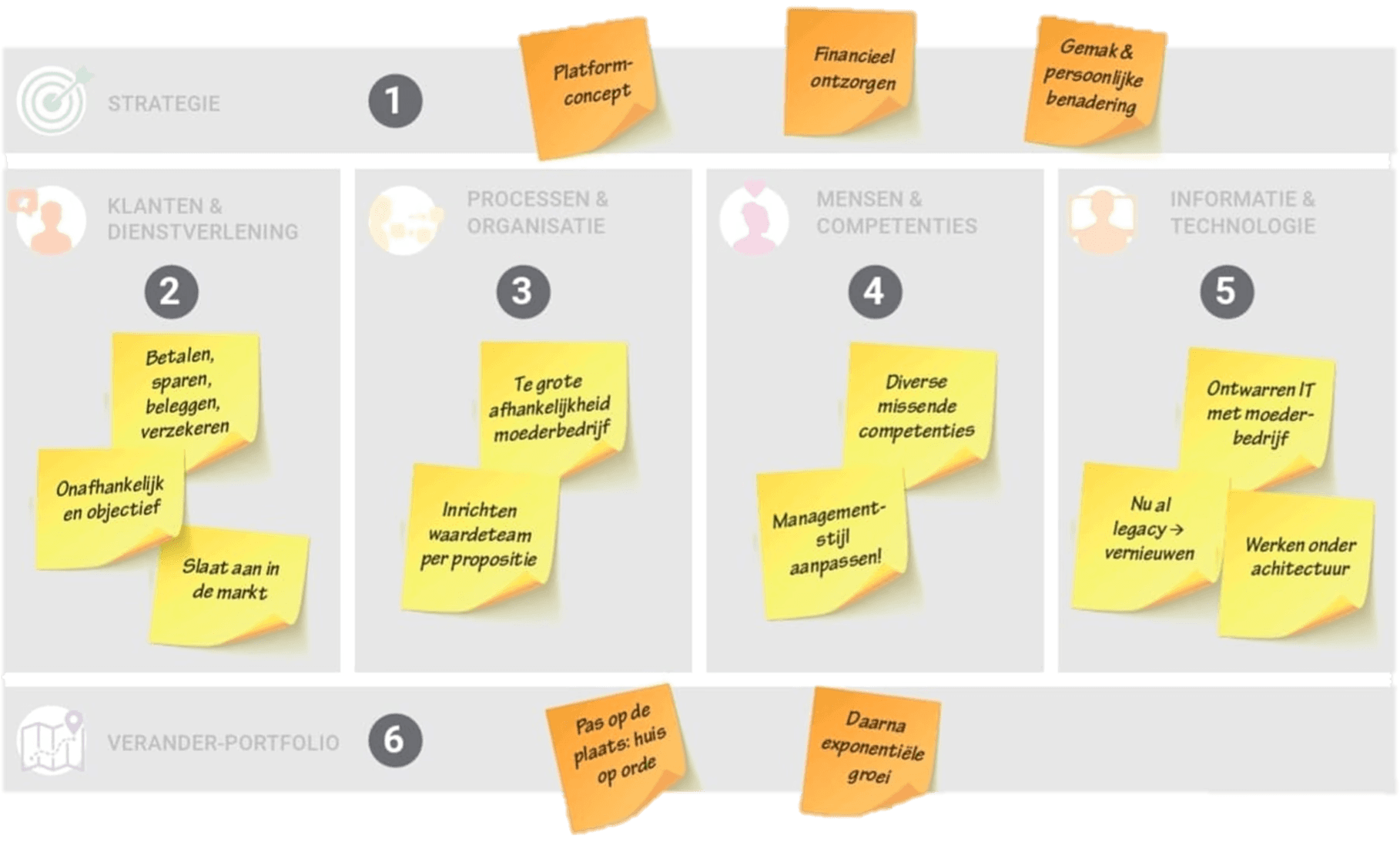
After thirty-five years of experience as the founder of the Business Transformation Framework, Marc Beijen is changing course. In his latest book, written with his former colleagues at Novius, Ruben Heetebrij and Roos Tigchelaar, he introduces the Business Transformation Canvas. Whereas organisations used to get bogged down for months in voluminous plans that were already obsolete by the time they were completed, this new model offers the speed required by today's “digital vortex”.
The biggest breakthroughs? First, the explicit focus on the human factor and culture, which makes the upper stream more explicit and transparent and the undercurrent more recognisable, making it easier to steer people in the right direction. In addition, the level of detail in the various gradations of the canvas's components has been critically revised, making it possible to capture powerful core messages for individual components on just one page with the Business Transformation Canvas.
Curious about how you can translate complex transitions into an agile design that creates speed and support? Discover the further development of the methodology in the interview and take the first step towards your change.

'DIGITAL TRANSFORMATION,
HOW DO YOU DO IT?'
Figures on the success rate of digital transformations vary widely, but experts agree on one thing: it is disappointingly low. In “Successful Digital Transformation”, Marc Beijen takes those involved in digital transformation on a journey in which they learn how to increase their success rate.
‘I see the top echelons of business and government struggling with digital transformation,’ says Marc. "Everyone agrees: organisations need to get to work on digital transformation.
However, bringing digital initiatives to fruition is a journey fraught with challenges. There are quite a few questions,‘ he explains. ’Why, where and when do you start with digital transformation and how does this fit in with your goals? How do you create an overview and determine what is relevant to you? How do you allocate scarce resources between maintaining the current business, structural improvements and radical innovations?"
‘Technology is accelerating at a dizzying pace,’ Marc explains. ‘As a result, keeping up with digitalisation is no longer a priority, but a necessity.’ Read the full article now to discover how your organisation can increase its success rate!

'SUCCESSFUL DIGITAL TRANSFORMATION
CALLS FOR NEW LEADERSHIP'
Radical changes are happening everywhere. Consumer needs and behaviour are fundamentally changing. New organisations are appearing on the market with new business models, positioning themselves ahead of the original service provider in contact with the customer. They steal your customer contact and push you into a supplier role with marginal returns. At the same time, technological progress is accelerating at a dizzying pace for organisations. Digital innovation is becoming increasingly important for organisations. And managers cannot leave this to specialists or consultants, but must take a structural approach to it themselves.
It starts with formulating a sharp digital strategy. But this is only the beginning. You will need to have the entire change cycle in your organisation properly organised; focus on changes that create the most value; organise execution power to implement these changes quickly but also with the right quality. And your organisation will need to have a great capacity for learning in order to make short-cycle adjustments and learn from failures and successes. When implementing the strategy, there are quite a few factors that influence its success or failure. Want to know exactly what these factors are? Read the entire article to find out!
AG Connect january/february 2021


‘WHY 95% OF AI-PROJECTS FAIL'
Rikkert van Capelleveen and Hans Mulder observe that AI projects face exactly the same obstacles that traditional IT projects have been encountering for decades. But every cloud has a silver lining: the lessons for AI projects are there for the taking, thanks to over thirty years of experience with failed IT projects.
The rise of artificial intelligence is often presented as a revolution that fundamentally changes business operations. Yet the recent MIT report ‘Achieving Individual, Organisation, and Societal Value with AI’ shows that reality is more stubborn.
The study refers to a GenAI Divide: as many as 95% of AI projects fail to deliver measurable value. Only a small minority actually manage to create an impact.
This finding may sound surprising, but it is closely aligned with a long history of research into IT projects. Since the 1990s, the Standish Group has been monitoring the success and failure of large-scale IT initiatives through its CHAOS reports.
What do these insights mean for executives and decision-makers? Three key lessons emerge from both CHAOS and MIT. If you’re curious to find out what they are, read the article now!

'COMPLEX TRANSFORMATION? HOW IT BECOMES MANAGEABLE'
Many organisations are able to formulate a strategy, but its implementation often runs into problems, observes Marc Beijen. One useful tool is the Business Transformation Canvas, which can be used to map out digital business transformation in a coherent manner. The outside world is becoming increasingly dynamic, partly due to the influence of new technologies, and organisations are by no means easy to fathom either. Business models are changing, data, tech and AI are influencing the playing field, customers and regulators are setting new requirements, and the rules of the game are constantly changing. Successful digital business transformation is therefore high on the agenda for many organisations. But a recurring question is: how do we go about it?
To properly execute a transformation, you need to make hundreds of design choices, spanning all sorts of different disciplines and at varying levels of detail. Choices that are also interrelated and interact with one another. This places considerable demands on the organisation. In this article, we therefore take a detailed look at the steps of the Business Transformation Canvas. Read on to discover how your organisation, with the help of the Business Transformation Canvas, can successfully tackle this challenge!
AG Connect 2-2026 (april 2026)

'A CANVAS WORKS BETTER THAN A THICK STACK OF PAPER'
After thirty-five years of experience as the founder of the Business Transformation Framework, Marc Beijen is changing course. In his latest book, written with his former colleagues at Novius, Ruben Heetebrij and Roos Tigchelaar, he introduces the Business Transformation Canvas. Whereas organisations used to get bogged down for months in voluminous plans that were already obsolete by the time they were completed, this new model offers the speed required by today's “digital vortex”.
The biggest breakthroughs? First, the explicit focus on the human factor and culture, which makes the upper stream more explicit and transparent and the undercurrent more recognisable, making it easier to steer people in the right direction. In addition, the level of detail in the various gradations of the canvas's components has been critically revised, making it possible to capture powerful core messages for individual components on just one page with the Business Transformation Canvas.
Curious about how you can translate complex transitions into an agile design that creates speed and support? Discover the further development of the methodology in the interview and take the first step towards your change.
'DIGITAL TRANSFORMATION,
HOW DO YOU DO IT?'
Figures on the success rate of digital transformations vary widely, but experts agree on one thing: it is disappointingly low. In “Successful Digital Transformation”, Marc Beijen takes those involved in digital transformation on a journey in which they learn how to increase their success rate.
‘I see the top echelons of business and government struggling with digital transformation,’ says Marc. "Everyone agrees: organisations need to get to work on digital transformation.
However, bringing digital initiatives to fruition is a journey fraught with challenges. There are quite a few questions,‘ he explains. ’Why, where and when do you start with digital transformation and how does this fit in with your goals? How do you create an overview and determine what is relevant to you? How do you allocate scarce resources between maintaining the current business, structural improvements and radical innovations?"
‘Technology is accelerating at a dizzying pace,’ Marc explains. ‘As a result, keeping up with digitalisation is no longer a priority, but a necessity.’ Read the full article now to discover how your organisation can increase its success rate!
'SUCCESSFUL DIGITAL TRANSFORMATION
CALLS FOR NEW LEADERSHIP'
Radical changes are happening everywhere. Consumer needs and behaviour are fundamentally changing. New organisations are appearing on the market with new business models, positioning themselves ahead of the original service provider in contact with the customer. They steal your customer contact and push you into a supplier role with marginal returns. At the same time, technological progress is accelerating at a dizzying pace for organisations. Digital innovation is becoming increasingly important for organisations. And managers cannot leave this to specialists or consultants, but must take a structural approach to it themselves.
It starts with formulating a sharp digital strategy. But this is only the beginning. You will need to have the entire change cycle in your organisation properly organised; focus on changes that create the most value; organise execution power to implement these changes quickly but also with the right quality. And your organisation will need to have a great capacity for learning in order to make short-cycle adjustments and learn from failures and successes. When implementing the strategy, there are quite a few factors that influence its success or failure. Want to know exactly what these factors are? Read the entire article to find out!
AG Connect january/february 2021
‘WHY 95% OF AI-PROJECTS FAIL'
Rikkert van Capelleveen and Hans Mulder observe that AI projects face exactly the same obstacles that traditional IT projects have been encountering for decades. But every cloud has a silver lining: the lessons for AI projects are there for the taking, thanks to over thirty years of experience with failed IT projects.
The rise of artificial intelligence is often presented as a revolution that fundamentally changes business operations. Yet the recent MIT report ‘Achieving Individual, Organisation, and Societal Value with AI’ shows that reality is more stubborn.
The study refers to a GenAI Divide: as many as 95% of AI projects fail to deliver measurable value. Only a small minority actually manage to create an impact.
This finding may sound surprising, but it is closely aligned with a long history of research into IT projects. Since the 1990s, the Standish Group has been monitoring the success and failure of large-scale IT initiatives through its CHAOS reports.
What do these insights mean for executives and decision-makers? Three key lessons emerge from both CHAOS and MIT. If you’re curious to find out what they are, read the article now!
'COMPLEX TRANSFORMATION? HOW IT BECOMES MANAGEABLE'
Many organisations are able to formulate a strategy, but its implementation often runs into problems, observes Marc Beijen. One useful tool is the Business Transformation Canvas, which can be used to map out digital business transformation in a coherent manner. The outside world is becoming increasingly dynamic, partly due to the influence of new technologies, and organisations are by no means easy to fathom either. Business models are changing, data, tech and AI are influencing the playing field, customers and regulators are setting new requirements, and the rules of the game are constantly changing. Successful digital business transformation is therefore high on the agenda for many organisations. But a recurring question is: how do we go about it?
To properly execute a transformation, you need to make hundreds of design choices, spanning all sorts of different disciplines and at varying levels of detail. Choices that are also interrelated and interact with one another. This places considerable demands on the organisation. In this article, we therefore take a detailed look at the steps of the Business Transformation Canvas. Read on to discover how your organisation, with the help of the Business Transformation Canvas, can successfully tackle this challenge!
AG Connect 2-2026 (april 2026)
'A CANVAS WORKS BETTER THAN A THICK STACK OF PAPER'
After thirty-five years of experience as the founder of the Business Transformation Framework, Marc Beijen is changing course. In his latest book, written with his former colleagues at Novius, Ruben Heetebrij and Roos Tigchelaar, he introduces the Business Transformation Canvas. Whereas organisations used to get bogged down for months in voluminous plans that were already obsolete by the time they were completed, this new model offers the speed required by today's “digital vortex”.
The biggest breakthroughs? First, the explicit focus on the human factor and culture, which makes the upper stream more explicit and transparent and the undercurrent more recognisable, making it easier to steer people in the right direction. In addition, the level of detail in the various gradations of the canvas's components has been critically revised, making it possible to capture powerful core messages for individual components on just one page with the Business Transformation Canvas.
Curious about how you can translate complex transitions into an agile design that creates speed and support? Discover the further development of the methodology in the interview and take the first step towards your change.
'DIGITAL TRANSFORMATION,
HOW DO YOU DO IT?'
Figures on the success rate of digital transformations vary widely, but experts agree on one thing: it is disappointingly low. In “Successful Digital Transformation”, Marc Beijen takes those involved in digital transformation on a journey in which they learn how to increase their success rate.
‘I see the top echelons of business and government struggling with digital transformation,’ says Marc. "Everyone agrees: organisations need to get to work on digital transformation.
However, bringing digital initiatives to fruition is a journey fraught with challenges. There are quite a few questions,‘ he explains. ’Why, where and when do you start with digital transformation and how does this fit in with your goals? How do you create an overview and determine what is relevant to you? How do you allocate scarce resources between maintaining the current business, structural improvements and radical innovations?"
‘Technology is accelerating at a dizzying pace,’ Marc explains. ‘As a result, keeping up with digitalisation is no longer a priority, but a necessity.’ Read the full article now to discover how your organisation can increase its success rate!
'SUCCESSFUL DIGITAL TRANSFORMATION
CALLS FOR NEW LEADERSHIP'
Radical changes are happening everywhere. Consumer needs and behaviour are fundamentally changing. New organisations are appearing on the market with new business models, positioning themselves ahead of the original service provider in contact with the customer. They steal your customer contact and push you into a supplier role with marginal returns. At the same time, technological progress is accelerating at a dizzying pace for organisations. Digital innovation is becoming increasingly important for organisations. And managers cannot leave this to specialists or consultants, but must take a structural approach to it themselves.
It starts with formulating a sharp digital strategy. But this is only the beginning. You will need to have the entire change cycle in your organisation properly organised; focus on changes that create the most value; organise execution power to implement these changes quickly but also with the right quality. And your organisation will need to have a great capacity for learning in order to make short-cycle adjustments and learn from failures and successes. When implementing the strategy, there are quite a few factors that influence its success or failure. Want to know exactly what these factors are? Read the entire article to find out!
AG Connect january/february 2021
‘WHY 95% OF AI-PROJECTS FAIL'
Rikkert van Capelleveen and Hans Mulder observe that AI projects face exactly the same obstacles that traditional IT projects have been encountering for decades. But every cloud has a silver lining: the lessons for AI projects are there for the taking, thanks to over thirty years of experience with failed IT projects.
The rise of artificial intelligence is often presented as a revolution that fundamentally changes business operations. Yet the recent MIT report ‘Achieving Individual, Organisation, and Societal Value with AI’ shows that reality is more stubborn.
The study refers to a GenAI Divide: as many as 95% of AI projects fail to deliver measurable value. Only a small minority actually manage to create an impact.
This finding may sound surprising, but it is closely aligned with a long history of research into IT projects. Since the 1990s, the Standish Group has been monitoring the success and failure of large-scale IT initiatives through its CHAOS reports.
What do these insights mean for executives and decision-makers? Three key lessons emerge from both CHAOS and MIT. If you’re curious to find out what they are, read the article now!
'COMPLEX TRANSFORMATION? HOW IT BECOMES MANAGEABLE'
Many organisations are able to formulate a strategy, but its implementation often runs into problems, observes Marc Beijen. One useful tool is the Business Transformation Canvas, which can be used to map out digital business transformation in a coherent manner. The outside world is becoming increasingly dynamic, partly due to the influence of new technologies, and organisations are by no means easy to fathom either. Business models are changing, data, tech and AI are influencing the playing field, customers and regulators are setting new requirements, and the rules of the game are constantly changing. Successful digital business transformation is therefore high on the agenda for many organisations. But a recurring question is: how do we go about it?
To properly execute a transformation, you need to make hundreds of design choices, spanning all sorts of different disciplines and at varying levels of detail. Choices that are also interrelated and interact with one another. This places considerable demands on the organisation. In this article, we therefore take a detailed look at the steps of the Business Transformation Canvas. Read on to discover how your organisation, with the help of the Business Transformation Canvas, can successfully tackle this challenge!
AG Connect 2-2026 (april 2026)
'A CANVAS WORKS BETTER THAN A THICK STACK OF PAPER'
After thirty-five years of experience as the founder of the Business Transformation Framework, Marc Beijen is changing course. In his latest book, written with his former colleagues at Novius, Ruben Heetebrij and Roos Tigchelaar, he introduces the Business Transformation Canvas. Whereas organisations used to get bogged down for months in voluminous plans that were already obsolete by the time they were completed, this new model offers the speed required by today's “digital vortex”.
The biggest breakthroughs? First, the explicit focus on the human factor and culture, which makes the upper stream more explicit and transparent and the undercurrent more recognisable, making it easier to steer people in the right direction. In addition, the level of detail in the various gradations of the canvas's components has been critically revised, making it possible to capture powerful core messages for individual components on just one page with the Business Transformation Canvas.
Curious about how you can translate complex transitions into an agile design that creates speed and support? Discover the further development of the methodology in the interview and take the first step towards your change.
'DIGITAL TRANSFORMATION,
HOW DO YOU DO IT?'
Figures on the success rate of digital transformations vary widely, but experts agree on one thing: it is disappointingly low. In “Successful Digital Transformation”, Marc Beijen takes those involved in digital transformation on a journey in which they learn how to increase their success rate.
‘I see the top echelons of business and government struggling with digital transformation,’ says Marc. "Everyone agrees: organisations need to get to work on digital transformation.
However, bringing digital initiatives to fruition is a journey fraught with challenges. There are quite a few questions,‘ he explains. ’Why, where and when do you start with digital transformation and how does this fit in with your goals? How do you create an overview and determine what is relevant to you? How do you allocate scarce resources between maintaining the current business, structural improvements and radical innovations?"
‘Technology is accelerating at a dizzying pace,’ Marc explains. ‘As a result, keeping up with digitalisation is no longer a priority, but a necessity.’ Read the full article now to discover how your organisation can increase its success rate!
'SUCCESSFUL DIGITAL TRANSFORMATION
CALLS FOR NEW LEADERSHIP'
Radical changes are happening everywhere. Consumer needs and behaviour are fundamentally changing. New organisations are appearing on the market with new business models, positioning themselves ahead of the original service provider in contact with the customer. They steal your customer contact and push you into a supplier role with marginal returns. At the same time, technological progress is accelerating at a dizzying pace for organisations. Digital innovation is becoming increasingly important for organisations. And managers cannot leave this to specialists or consultants, but must take a structural approach to it themselves.
It starts with formulating a sharp digital strategy. But this is only the beginning. You will need to have the entire change cycle in your organisation properly organised; focus on changes that create the most value; organise execution power to implement these changes quickly but also with the right quality. And your organisation will need to have a great capacity for learning in order to make short-cycle adjustments and learn from failures and successes. When implementing the strategy, there are quite a few factors that influence its success or failure. Want to know exactly what these factors are? Read the entire article to find out!
AG Connect january/february 2021
‘WHY 95% OF AI-PROJECTS FAIL'
Rikkert van Capelleveen and Hans Mulder observe that AI projects face exactly the same obstacles that traditional IT projects have been encountering for decades. But every cloud has a silver lining: the lessons for AI projects are there for the taking, thanks to over thirty years of experience with failed IT projects.
The rise of artificial intelligence is often presented as a revolution that fundamentally changes business operations. Yet the recent MIT report ‘Achieving Individual, Organisation, and Societal Value with AI’ shows that reality is more stubborn.
The study refers to a GenAI Divide: as many as 95% of AI projects fail to deliver measurable value. Only a small minority actually manage to create an impact.
This finding may sound surprising, but it is closely aligned with a long history of research into IT projects. Since the 1990s, the Standish Group has been monitoring the success and failure of large-scale IT initiatives through its CHAOS reports.
What do these insights mean for executives and decision-makers? Three key lessons emerge from both CHAOS and MIT. If you’re curious to find out what they are, read the article now!
'COMPLEX TRANSFORMATION? HOW IT BECOMES MANAGEABLE'
Many organisations are able to formulate a strategy, but its implementation often runs into problems, observes Marc Beijen. One useful tool is the Business Transformation Canvas, which can be used to map out digital business transformation in a coherent manner. The outside world is becoming increasingly dynamic, partly due to the influence of new technologies, and organisations are by no means easy to fathom either. Business models are changing, data, tech and AI are influencing the playing field, customers and regulators are setting new requirements, and the rules of the game are constantly changing. Successful digital business transformation is therefore high on the agenda for many organisations. But a recurring question is: how do we go about it?
To properly execute a transformation, you need to make hundreds of design choices, spanning all sorts of different disciplines and at varying levels of detail. Choices that are also interrelated and interact with one another. This places considerable demands on the organisation. In this article, we therefore take a detailed look at the steps of the Business Transformation Canvas. Read on to discover how your organisation, with the help of the Business Transformation Canvas, can successfully tackle this challenge!
AG Connect 2-2026 (april 2026)
BUSINESS TRANSFORMATION CANVAS
Organisations are often perfectly capable of drawing up a strategy. Countless books have been written on the subject and methods developed. But the question of how to actually execute this strategy proves to be much more difficult. A strategy without a clear execution plan is often nothing more than hot air. Discover how to execute your strategy and bring about successful change with the Business Transformation Canvas.
‘An indispensable tool for successfully realising business strategies and ambitions.’
‘The Business Transformation Canvas provides exactly the guidance you need: it helps you organise your ambitions and initiatives, create coherence and make sharp choices.’
‘Marc describes this in an accessible and concrete way, without woolly language but with immediately applicable tools. This book is a valuable guide that connects theory and practice in an inspiring way.’
AUTHORS: Marc Beijen, Ruben Heetebrij & Roos Tigchelaar
PUBLISHER: Van Haren Publishing
ISBN: 9789401813693 (Dutch)
SUCCESSFUL DIGITAL TRANSFORMATION
Successful Digital Transformation is a guide and reference work for anyone involved in the management or substantive implementation of digital transformation. The book is primarily aimed at managers and directors at the strategic and tactical level, but also at anyone involved in achieving digital transformation: business developers, marketers, line management, consultants, analysts, IT professionals, architects, and programme and change managers.
This book emphasises that there is a considerable need for organisations to tackle digital transformation in a bold and ambitious manner. The fear of making mistakes must be put aside; only by doing and learning can speed be achieved. With this book, Marc Beijen makes the complexity associated with digital transformations manageable again. By introducing structure, unravelling issues and considering them holistically, in context. By distinguishing between main and side issues, applying the 80/20 rule and setting clear priorities. The core message is that organisations need to get to work if they want to continue to play a leading role in their market.
AUTHOR: Marc Beijen
PUBLISHER: Van Haren Publishing
ISBN: 9789401807739 (English)
PROGRAMME MANAGEMENT SELECTION MENU
The Programme Management Selection Menu describes the six most important visions in the Netherlands in the field of programme management. Programme management is the management of the relationship between projects and organisational change in order to achieve one (or more) strategic objectives.
Many colleagues and clients are unaware that there are multiple visions on programme management and that alternatives are therefore available. The book provides insight into the different visions, how these visions came about and the strengths of each vision. The six visions are also compared with each other. When designing large-scale changes, this book offers guidance in choosing a particular programme management vision and the associated methodology.
We are proud that our vision on programme management – integral programme management – has been included in this book as one of the six visions on programme management in the Netherlands. The IPM vision was published in 2008 by David de Graaf at Academic Services.
AUTHORS: René Hombergen, David de Graaf e.a.
PUBLISHER: Scriptum
ISBN: 9789055948765 (Dutch)
STRATEGIC USE OF ICT
There is a growing awareness in the business community and government that information and communication technology has become an indispensable tool. ICT is no longer the preserve of automation specialists, but now also requires the full attention and guidance of managers.
How can they structurally and fundamentally improve the performance of their organisations through the optimal use of ICT?
The authors describe innovative visions and concepts for doing business with ICT and provide guidance on how to implement and manage them. Well-known and proven methods and techniques are combined in a practical framework.
The principles of this framework – every situation requires a tailor-made approach and the use of ICT is a business issue, not an ICT issue, and therefore belongs with managers – are applicable in both large and small organisations.
AUTHORS: Marc Beijen, Eric Broos & Etienne Lucas
PUBLISHER: Boom
ISBN: 9789014074276 (Dutch)
INTEGRATED PROGRAMME MANAGEMENT
Control over the process, content and change. David de Graaf describes in practical terms how an organisation's strategy and business objectives can be achieved through the use of programme management to control projects.
He outlines the relationship with project portfolio management, (multi)project management and business and information planning. Not only does he discuss the administrative side of programme management, but also the approach to achieving substantive control of programmes through the use of architecture.
In addition to the rational and instrumental side of programme management, explicit attention is given to the change management or human aspects that come into play in large-scale changes.
This book – which includes many concrete practical examples – is written for anyone who is directly or indirectly involved in the programme management of business projects with a large ICT component.
AUTHOR: David de graaf
PUBLISHER: Academic service
ISBN: 9789012117791 (Dutch)
INFORMATION PLANNING AND CONTROL
How can you structurally and fundamentally improve your organisation's performance through the optimal use of ICT?
This is the issue you are facing, and this is what Information Planning and Control is all about. It describes innovative visions and concepts for the use of ICT and offers guidance on how to implement and manage them.
Well-known and proven methods and techniques are combined in a single clear and practical framework. The principles of this framework are applicable in both large and small organisations.
The concepts, guidelines, methods and techniques described are of interest to anyone in the business community and government who is involved in improving their organisation through the use of ICT: (line) managers, marketers, controllers, personnel organisation and information advisors (internal and external), information managers and ICT professionals.
AUTHORS: Marc Beijen, Eric Broos & Jan Herbrink
PUBLISHER: Ten Hagen Stam
ISBN: 9789026718977 (Dutch)
BUSINESS TRANSFORMATION CANVAS
Organisations are often perfectly capable of drawing up a strategy. Countless books have been written on the subject and methods developed. But the question of how to actually execute this strategy proves to be much more difficult. A strategy without a clear execution plan is often nothing more than hot air. Discover how to execute your strategy and bring about successful change with the Business Transformation Canvas.
‘An indispensable tool for successfully realising business strategies and ambitions.’
‘The Business Transformation Canvas provides exactly the guidance you need: it helps you organise your ambitions and initiatives, create coherence and make sharp choices.’
‘Marc describes this in an accessible and concrete way, without woolly language but with immediately applicable tools. This book is a valuable guide that connects theory and practice in an inspiring way.’
AUTHORS: Marc Beijen, Ruben Heetebrij & Roos Tigchelaar
PUBLISHER: Van Haren Publishing
ISBN: 9789401813693 (Dutch)
SUCCESSFUL DIGITAL TRANSFORMATION
Successful Digital Transformation is a guide and reference work for anyone involved in the management or substantive implementation of digital transformation. The book is primarily aimed at managers and directors at the strategic and tactical level, but also at anyone involved in achieving digital transformation: business developers, marketers, line management, consultants, analysts, IT professionals, architects, and programme and change managers.
This book emphasises that there is a considerable need for organisations to tackle digital transformation in a bold and ambitious manner. The fear of making mistakes must be put aside; only by doing and learning can speed be achieved. With this book, Marc Beijen makes the complexity associated with digital transformations manageable again. By introducing structure, unravelling issues and considering them holistically, in context. By distinguishing between main and side issues, applying the 80/20 rule and setting clear priorities. The core message is that organisations need to get to work if they want to continue to play a leading role in their market.
AUTHOR: Marc Beijen
PUBLISHER: Van Haren Publishing
ISBN: 9789401807739 (English)
PROGRAMME MANAGEMENT SELECTION MENU
The Programme Management Selection Menu describes the six most important visions in the Netherlands in the field of programme management. Programme management is the management of the relationship between projects and organisational change in order to achieve one (or more) strategic objectives.
Many colleagues and clients are unaware that there are multiple visions on programme management and that alternatives are therefore available. The book provides insight into the different visions, how these visions came about and the strengths of each vision. The six visions are also compared with each other. When designing large-scale changes, this book offers guidance in choosing a particular programme management vision and the associated methodology.
We are proud that our vision on programme management – integral programme management – has been included in this book as one of the six visions on programme management in the Netherlands. The IPM vision was published in 2008 by David de Graaf at Academic Services.
AUTHORS: René Hombergen, David de Graaf e.a.
PUBLISHER: Scriptum
ISBN: 9789055948765 (Dutch)
STRATEGIC USE OF ICT
There is a growing awareness in the business community and government that information and communication technology has become an indispensable tool. ICT is no longer the preserve of automation specialists, but now also requires the full attention and guidance of managers.
How can they structurally and fundamentally improve the performance of their organisations through the optimal use of ICT?
The authors describe innovative visions and concepts for doing business with ICT and provide guidance on how to implement and manage them. Well-known and proven methods and techniques are combined in a practical framework.
The principles of this framework – every situation requires a tailor-made approach and the use of ICT is a business issue, not an ICT issue, and therefore belongs with managers – are applicable in both large and small organisations.
AUTHORS: Marc Beijen, Eric Broos & Etienne Lucas
PUBLISHER: Boom
ISBN: 9789014074276 (Dutch)
INTEGRATED PROGRAMME MANAGEMENT
Control over the process, content and change. David de Graaf describes in practical terms how an organisation's strategy and business objectives can be achieved through the use of programme management to control projects.
He outlines the relationship with project portfolio management, (multi)project management and business and information planning. Not only does he discuss the administrative side of programme management, but also the approach to achieving substantive control of programmes through the use of architecture.
In addition to the rational and instrumental side of programme management, explicit attention is given to the change management or human aspects that come into play in large-scale changes.
This book – which includes many concrete practical examples – is written for anyone who is directly or indirectly involved in the programme management of business projects with a large ICT component.
AUTHOR: David de graaf
PUBLISHER: Academic service
ISBN: 9789012117791 (Dutch)
INFORMATION PLANNING AND CONTROL
How can you structurally and fundamentally improve your organisation's performance through the optimal use of ICT?
This is the issue you are facing, and this is what Information Planning and Control is all about. It describes innovative visions and concepts for the use of ICT and offers guidance on how to implement and manage them.
Well-known and proven methods and techniques are combined in a single clear and practical framework. The principles of this framework are applicable in both large and small organisations.
The concepts, guidelines, methods and techniques described are of interest to anyone in the business community and government who is involved in improving their organisation through the use of ICT: (line) managers, marketers, controllers, personnel organisation and information advisors (internal and external), information managers and ICT professionals.
AUTHORS: Marc Beijen, Eric Broos & Jan Herbrink
PUBLISHER: Ten Hagen Stam
ISBN: 9789026718977 (Dutch)
BUSINESS TRANSFORMATION CANVAS
Organisations are often perfectly capable of drawing up a strategy. Countless books have been written on the subject and methods developed. But the question of how to actually execute this strategy proves to be much more difficult. A strategy without a clear execution plan is often nothing more than hot air. Discover how to execute your strategy and bring about successful change with the Business Transformation Canvas.
‘An indispensable tool for successfully realising business strategies and ambitions.’
‘The Business Transformation Canvas provides exactly the guidance you need: it helps you organise your ambitions and initiatives, create coherence and make sharp choices.’
‘Marc describes this in an accessible and concrete way, without woolly language but with immediately applicable tools. This book is a valuable guide that connects theory and practice in an inspiring way.’
AUTHORS: Marc Beijen, Ruben Heetebrij & Roos Tigchelaar
PUBLISHER: Van Haren Publishing
ISBN: 9789401813693 (Dutch)
SUCCESSFUL DIGITAL TRANSFORMATION
Successful Digital Transformation is a guide and reference work for anyone involved in the management or substantive implementation of digital transformation. The book is primarily aimed at managers and directors at the strategic and tactical level, but also at anyone involved in achieving digital transformation: business developers, marketers, line management, consultants, analysts, IT professionals, architects, and programme and change managers.
This book emphasises that there is a considerable need for organisations to tackle digital transformation in a bold and ambitious manner. The fear of making mistakes must be put aside; only by doing and learning can speed be achieved. With this book, Marc Beijen makes the complexity associated with digital transformations manageable again. By introducing structure, unravelling issues and considering them holistically, in context. By distinguishing between main and side issues, applying the 80/20 rule and setting clear priorities. The core message is that organisations need to get to work if they want to continue to play a leading role in their market.
AUTHOR: Marc Beijen
PUBLISHER: Van Haren Publishing
ISBN: 9789401807739 (English)
PROGRAMME MANAGEMENT SELECTION MENU
The Programme Management Selection Menu describes the six most important visions in the Netherlands in the field of programme management. Programme management is the management of the relationship between projects and organisational change in order to achieve one (or more) strategic objectives.
Many colleagues and clients are unaware that there are multiple visions on programme management and that alternatives are therefore available. The book provides insight into the different visions, how these visions came about and the strengths of each vision. The six visions are also compared with each other. When designing large-scale changes, this book offers guidance in choosing a particular programme management vision and the associated methodology.
We are proud that our vision on programme management – integral programme management – has been included in this book as one of the six visions on programme management in the Netherlands. The IPM vision was published in 2008 by David de Graaf at Academic Services.
AUTHORS: René Hombergen, David de Graaf e.a.
PUBLISHER: Scriptum
ISBN: 9789055948765 (Dutch)
STRATEGIC USE OF ICT
There is a growing awareness in the business community and government that information and communication technology has become an indispensable tool. ICT is no longer the preserve of automation specialists, but now also requires the full attention and guidance of managers.
How can they structurally and fundamentally improve the performance of their organisations through the optimal use of ICT?
The authors describe innovative visions and concepts for doing business with ICT and provide guidance on how to implement and manage them. Well-known and proven methods and techniques are combined in a practical framework.
The principles of this framework – every situation requires a tailor-made approach and the use of ICT is a business issue, not an ICT issue, and therefore belongs with managers – are applicable in both large and small organisations.
AUTHORS: Marc Beijen, Eric Broos & Etienne Lucas
PUBLISHER: Boom
ISBN: 9789014074276 (Dutch)
INTEGRATED PROGRAMME MANAGEMENT
Control over the process, content and change. David de Graaf describes in practical terms how an organisation's strategy and business objectives can be achieved through the use of programme management to control projects.
He outlines the relationship with project portfolio management, (multi)project management and business and information planning. Not only does he discuss the administrative side of programme management, but also the approach to achieving substantive control of programmes through the use of architecture.
In addition to the rational and instrumental side of programme management, explicit attention is given to the change management or human aspects that come into play in large-scale changes.
This book – which includes many concrete practical examples – is written for anyone who is directly or indirectly involved in the programme management of business projects with a large ICT component.
AUTHOR: David de graaf
PUBLISHER: Academic service
ISBN: 9789012117791 (Dutch)
INFORMATION PLANNING AND CONTROL
How can you structurally and fundamentally improve your organisation's performance through the optimal use of ICT?
This is the issue you are facing, and this is what Information Planning and Control is all about. It describes innovative visions and concepts for the use of ICT and offers guidance on how to implement and manage them.
Well-known and proven methods and techniques are combined in a single clear and practical framework. The principles of this framework are applicable in both large and small organisations.
The concepts, guidelines, methods and techniques described are of interest to anyone in the business community and government who is involved in improving their organisation through the use of ICT: (line) managers, marketers, controllers, personnel organisation and information advisors (internal and external), information managers and ICT professionals.
AUTHORS: Marc Beijen, Eric Broos & Jan Herbrink
PUBLISHER: Ten Hagen Stam
ISBN: 9789026718977 (Dutch)
BUSINESS TRANSFORMATION CANVAS
Organisations are often perfectly capable of drawing up a strategy. Countless books have been written on the subject and methods developed. But the question of how to actually execute this strategy proves to be much more difficult. A strategy without a clear execution plan is often nothing more than hot air. Discover how to execute your strategy and bring about successful change with the Business Transformation Canvas.
‘An indispensable tool for successfully realising business strategies and ambitions.’
‘The Business Transformation Canvas provides exactly the guidance you need: it helps you organise your ambitions and initiatives, create coherence and make sharp choices.’
‘Marc describes this in an accessible and concrete way, without woolly language but with immediately applicable tools. This book is a valuable guide that connects theory and practice in an inspiring way.’
AUTHORS: Marc Beijen, Ruben Heetebrij & Roos Tigchelaar
PUBLISHER: Van Haren Publishing
ISBN: 9789401813693 (Dutch)
SUCCESSFUL DIGITAL TRANSFORMATION
Successful Digital Transformation is a guide and reference work for anyone involved in the management or substantive implementation of digital transformation. The book is primarily aimed at managers and directors at the strategic and tactical level, but also at anyone involved in achieving digital transformation: business developers, marketers, line management, consultants, analysts, IT professionals, architects, and programme and change managers.
This book emphasises that there is a considerable need for organisations to tackle digital transformation in a bold and ambitious manner. The fear of making mistakes must be put aside; only by doing and learning can speed be achieved. With this book, Marc Beijen makes the complexity associated with digital transformations manageable again. By introducing structure, unravelling issues and considering them holistically, in context. By distinguishing between main and side issues, applying the 80/20 rule and setting clear priorities. The core message is that organisations need to get to work if they want to continue to play a leading role in their market.
AUTHOR: Marc Beijen
PUBLISHER: Van Haren Publishing
ISBN: 9789401807739 (English)
PROGRAMME MANAGEMENT SELECTION MENU
The Programme Management Selection Menu describes the six most important visions in the Netherlands in the field of programme management. Programme management is the management of the relationship between projects and organisational change in order to achieve one (or more) strategic objectives.
Many colleagues and clients are unaware that there are multiple visions on programme management and that alternatives are therefore available. The book provides insight into the different visions, how these visions came about and the strengths of each vision. The six visions are also compared with each other. When designing large-scale changes, this book offers guidance in choosing a particular programme management vision and the associated methodology.
We are proud that our vision on programme management – integral programme management – has been included in this book as one of the six visions on programme management in the Netherlands. The IPM vision was published in 2008 by David de Graaf at Academic Services.
AUTHORS: René Hombergen, David de Graaf e.a.
PUBLISHER: Scriptum
ISBN: 9789055948765 (Dutch)
STRATEGIC USE OF ICT
There is a growing awareness in the business community and government that information and communication technology has become an indispensable tool. ICT is no longer the preserve of automation specialists, but now also requires the full attention and guidance of managers.
How can they structurally and fundamentally improve the performance of their organisations through the optimal use of ICT?
The authors describe innovative visions and concepts for doing business with ICT and provide guidance on how to implement and manage them. Well-known and proven methods and techniques are combined in a practical framework.
The principles of this framework – every situation requires a tailor-made approach and the use of ICT is a business issue, not an ICT issue, and therefore belongs with managers – are applicable in both large and small organisations.
AUTHORS: Marc Beijen, Eric Broos & Etienne Lucas
PUBLISHER: Boom
ISBN: 9789014074276 (Dutch)
INTEGRATED PROGRAMME MANAGEMENT
Control over the process, content and change. David de Graaf describes in practical terms how an organisation's strategy and business objectives can be achieved through the use of programme management to control projects.
He outlines the relationship with project portfolio management, (multi)project management and business and information planning. Not only does he discuss the administrative side of programme management, but also the approach to achieving substantive control of programmes through the use of architecture.
In addition to the rational and instrumental side of programme management, explicit attention is given to the change management or human aspects that come into play in large-scale changes.
This book – which includes many concrete practical examples – is written for anyone who is directly or indirectly involved in the programme management of business projects with a large ICT component.
AUTHOR: David de graaf
PUBLISHER: Academic service
ISBN: 9789012117791 (Dutch)
INFORMATION PLANNING AND CONTROL
How can you structurally and fundamentally improve your organisation's performance through the optimal use of ICT?
This is the issue you are facing, and this is what Information Planning and Control is all about. It describes innovative visions and concepts for the use of ICT and offers guidance on how to implement and manage them.
Well-known and proven methods and techniques are combined in a single clear and practical framework. The principles of this framework are applicable in both large and small organisations.
The concepts, guidelines, methods and techniques described are of interest to anyone in the business community and government who is involved in improving their organisation through the use of ICT: (line) managers, marketers, controllers, personnel organisation and information advisors (internal and external), information managers and ICT professionals.
AUTHORS: Marc Beijen, Eric Broos & Jan Herbrink
PUBLISHER: Ten Hagen Stam
ISBN: 9789026718977 (Dutch)
OUR ARTICLES
OUR ARTICLES
OUR ARTICLES
‘A CANVAS WORKS BETTER THAN A THICK STACK OF PAPER'
After thirty-five years of experience as the founder of the Business Transformation Framework, Marc Beijen is changing course. In his latest book, written with his former colleagues at Novius, Ruben Heetebrij and Roos Tigchelaar, he introduces the Business Transformation Canvas. Whereas organisations used to get bogged down for months in voluminous plans that were already obsolete by the time they were completed, this new model offers the speed required by today's “digital vortex”.
The biggest breakthroughs? First, the explicit focus on the human factor and culture, which makes the upper stream more explicit and transparent and the undercurrent more recognisable, making it easier to steer people in the right direction. In addition, the level of detail in the various gradations of the canvas's components has been critically revised, making it possible to capture powerful core messages for individual components on just one page with the Business Transformation Canvas.
Curious about how you can translate complex transitions into an agile design that creates speed and support? Discover the further development of the methodology in the interview and take the first step towards your change.
‘DIGITAL TRANSFORMATION, HOW DO YOU DO IT?'
Figures on the success rate of digital transformations vary widely, but experts agree on one thing: it is disappointingly low. In “Successful Digital Transformation”, Marc Beijen takes those involved in digital transformation on a journey in which they learn how to increase their success rate.
‘I see the top echelons of business and government struggling with digital transformation,’ says Marc. "Everyone agrees: organisations need to get to work on digital transformation. However, bringing digital initiatives to fruition is a journey fraught with challenges. There are quite a few questions,‘ he explains. ’Why, where and when do you start with digital transformation and how does this fit in with your goals? How do you create an overview and determine what is relevant to you? How do you allocate scarce resources between maintaining the current business, structural improvements and radical innovations?"
‘Technology is accelerating at a dizzying pace,’ Marc explains. ‘As a result, keeping up with digitalisation is no longer a priority, but a necessity.’ Read the full article now to discover how your organisation can increase its success rate!
‘SUCCESSFUL DIGITAL TRANSFORMATION CALLS FOR NEW LEADERSHIP'
Radical changes are happening everywhere. Consumer needs and behaviour are fundamentally changing. New organisations are appearing on the market with new business models, positioning themselves ahead of the original service provider in contact with the customer. They steal your customer contact and push you into a supplier role with marginal returns. At the same time, technological progress is accelerating at a dizzying pace for organisations. Digital innovation is becoming increasingly important for organisations. And managers cannot leave this to specialists or consultants, but must take a structural approach to it themselves.
It starts with formulating a sharp digital strategy. But this is only the beginning. You will need to have the entire change cycle in your organisation properly organised; focus on changes that create the most value; organise execution power to implement these changes quickly but also with the right quality. And your organisation will need to have a great capacity for learning in order to make short-cycle adjustments and learn from failures and successes. When implementing the strategy, there are quite a few factors that influence its success or failure. Want to know exactly what these factors are? Read the entire article to find out!
AG Connect january/february 2021
‘WHY 95% OF AI-PROJECTS FAIL'
Rikkert van Capelleveen and Hans Mulder observe that AI projects face exactly the same obstacles that traditional IT projects have been encountering for decades. But every cloud has a silver lining: the lessons for AI projects are there for the taking, thanks to over thirty years of experience with failed IT projects.
The rise of artificial intelligence is often presented as a revolution that fundamentally changes business operations. Yet the recent MIT report ‘Achieving Individual, Organisation, and Societal Value with AI’ shows that reality is more stubborn. The study refers to a GenAI Divide: as many as 95% of AI projects fail to deliver measurable value. Only a small minority actually manage to create an impact.
This finding may sound surprising, but it is closely aligned with a long history of research into IT projects. Since the 1990s, the Standish Group has been monitoring the success and failure of large-scale IT initiatives through its CHAOS reports. What do these insights mean for executives and decision-makers? Three key lessons emerge from both CHAOS and MIT. If you’re curious to find out what they are, read the article now!
‘COMPLEX TRANSFORMATION? HOW IT BECOMES MANAGEABLE'
Many organisations are able to formulate a strategy, but its implementation often runs into problems, observes Marc Beijen. One useful tool is the Business Transformation Canvas, which can be used to map out digital business transformation in a coherent manner. The outside world is becoming increasingly dynamic, partly due to the influence of new technologies, and organisations are by no means easy to fathom either. Business models are changing, data, tech and AI are influencing the playing field, customers and regulators are setting new requirements, and the rules of the game are constantly changing. Successful digital business transformation is therefore high on the agenda for many organisations. But a recurring question is: how do we go about it?
To properly execute a transformation, you need to make hundreds of design choices, spanning all sorts of different disciplines and at varying levels of detail. Choices that are also interrelated and interact with one another. This places considerable demands on the organisation. In this article, we therefore take a detailed look at the steps of the Business Transformation Canvas. Read on to discover how your organisation, with the help of the Business Transformation Canvas, can successfully tackle this challenge!
AG Connect 2-2026 (april 2026)
‘A CANVAS WORKS BETTER THAN A THICK STACK OF PAPER'
After thirty-five years of experience as the founder of the Business Transformation Framework, Marc Beijen is changing course. In his latest book, written with his former colleagues at Novius, Ruben Heetebrij and Roos Tigchelaar, he introduces the Business Transformation Canvas. Whereas organisations used to get bogged down for months in voluminous plans that were already obsolete by the time they were completed, this new model offers the speed required by today's “digital vortex”.
The biggest breakthroughs? First, the explicit focus on the human factor and culture, which makes the upper stream more explicit and transparent and the undercurrent more recognisable, making it easier to steer people in the right direction. In addition, the level of detail in the various gradations of the canvas's components has been critically revised, making it possible to capture powerful core messages for individual components on just one page with the Business Transformation Canvas.
Curious about how you can translate complex transitions into an agile design that creates speed and support? Discover the further development of the methodology in the interview and take the first step towards your change.
‘DIGITAL TRANSFORMATION, HOW DO YOU DO IT?'
Figures on the success rate of digital transformations vary widely, but experts agree on one thing: it is disappointingly low. In “Successful Digital Transformation”, Marc Beijen takes those involved in digital transformation on a journey in which they learn how to increase their success rate.
‘I see the top echelons of business and government struggling with digital transformation,’ says Marc. "Everyone agrees: organisations need to get to work on digital transformation. However, bringing digital initiatives to fruition is a journey fraught with challenges. There are quite a few questions,‘ he explains. ’Why, where and when do you start with digital transformation and how does this fit in with your goals? How do you create an overview and determine what is relevant to you? How do you allocate scarce resources between maintaining the current business, structural improvements and radical innovations?"
‘Technology is accelerating at a dizzying pace,’ Marc explains. ‘As a result, keeping up with digitalisation is no longer a priority, but a necessity.’ Read the full article now to discover how your organisation can increase its success rate!
‘SUCCESSFUL DIGITAL TRANSFORMATION CALLS FOR NEW LEADERSHIP'
Radical changes are happening everywhere. Consumer needs and behaviour are fundamentally changing. New organisations are appearing on the market with new business models, positioning themselves ahead of the original service provider in contact with the customer. They steal your customer contact and push you into a supplier role with marginal returns. At the same time, technological progress is accelerating at a dizzying pace for organisations. Digital innovation is becoming increasingly important for organisations. And managers cannot leave this to specialists or consultants, but must take a structural approach to it themselves.
It starts with formulating a sharp digital strategy. But this is only the beginning. You will need to have the entire change cycle in your organisation properly organised; focus on changes that create the most value; organise execution power to implement these changes quickly but also with the right quality. And your organisation will need to have a great capacity for learning in order to make short-cycle adjustments and learn from failures and successes. When implementing the strategy, there are quite a few factors that influence its success or failure. Want to know exactly what these factors are? Read the entire article to find out!
AG Connect january/february 2021
‘WHY 95% OF AI-PROJECTS FAIL'
Rikkert van Capelleveen and Hans Mulder observe that AI projects face exactly the same obstacles that traditional IT projects have been encountering for decades. But every cloud has a silver lining: the lessons for AI projects are there for the taking, thanks to over thirty years of experience with failed IT projects.
The rise of artificial intelligence is often presented as a revolution that fundamentally changes business operations. Yet the recent MIT report ‘Achieving Individual, Organisation, and Societal Value with AI’ shows that reality is more stubborn. The study refers to a GenAI Divide: as many as 95% of AI projects fail to deliver measurable value. Only a small minority actually manage to create an impact.
This finding may sound surprising, but it is closely aligned with a long history of research into IT projects. Since the 1990s, the Standish Group has been monitoring the success and failure of large-scale IT initiatives through its CHAOS reports. What do these insights mean for executives and decision-makers? Three key lessons emerge from both CHAOS and MIT. If you’re curious to find out what they are, read the article now!
‘COMPLEX TRANSFORMATION? HOW IT BECOMES MANAGEABLE'
Many organisations are able to formulate a strategy, but its implementation often runs into problems, observes Marc Beijen. One useful tool is the Business Transformation Canvas, which can be used to map out digital business transformation in a coherent manner. The outside world is becoming increasingly dynamic, partly due to the influence of new technologies, and organisations are by no means easy to fathom either. Business models are changing, data, tech and AI are influencing the playing field, customers and regulators are setting new requirements, and the rules of the game are constantly changing. Successful digital business transformation is therefore high on the agenda for many organisations. But a recurring question is: how do we go about it?
To properly execute a transformation, you need to make hundreds of design choices, spanning all sorts of different disciplines and at varying levels of detail. Choices that are also interrelated and interact with one another. This places considerable demands on the organisation. In this article, we therefore take a detailed look at the steps of the Business Transformation Canvas. Read on to discover how your organisation, with the help of the Business Transformation Canvas, can successfully tackle this challenge!
AG Connect 2-2026 (april 2026)
‘A CANVAS WORKS BETTER THAN A THICK STACK OF PAPER'
After thirty-five years of experience as the founder of the Business Transformation Framework, Marc Beijen is changing course. In his latest book, written with his former colleagues at Novius, Ruben Heetebrij and Roos Tigchelaar, he introduces the Business Transformation Canvas. Whereas organisations used to get bogged down for months in voluminous plans that were already obsolete by the time they were completed, this new model offers the speed required by today's “digital vortex”.
The biggest breakthroughs? First, the explicit focus on the human factor and culture, which makes the upper stream more explicit and transparent and the undercurrent more recognisable, making it easier to steer people in the right direction. In addition, the level of detail in the various gradations of the canvas's components has been critically revised, making it possible to capture powerful core messages for individual components on just one page with the Business Transformation Canvas.
Curious about how you can translate complex transitions into an agile design that creates speed and support? Discover the further development of the methodology in the interview and take the first step towards your change.
‘DIGITAL TRANSFORMATION, HOW DO YOU DO IT?'
Figures on the success rate of digital transformations vary widely, but experts agree on one thing: it is disappointingly low. In “Successful Digital Transformation”, Marc Beijen takes those involved in digital transformation on a journey in which they learn how to increase their success rate.
‘I see the top echelons of business and government struggling with digital transformation,’ says Marc. "Everyone agrees: organisations need to get to work on digital transformation. However, bringing digital initiatives to fruition is a journey fraught with challenges. There are quite a few questions,‘ he explains. ’Why, where and when do you start with digital transformation and how does this fit in with your goals? How do you create an overview and determine what is relevant to you? How do you allocate scarce resources between maintaining the current business, structural improvements and radical innovations?"
‘Technology is accelerating at a dizzying pace,’ Marc explains. ‘As a result, keeping up with digitalisation is no longer a priority, but a necessity.’ Read the full article now to discover how your organisation can increase its success rate!
‘SUCCESSFUL DIGITAL TRANSFORMATION CALLS FOR NEW LEADERSHIP'
Radical changes are happening everywhere. Consumer needs and behaviour are fundamentally changing. New organisations are appearing on the market with new business models, positioning themselves ahead of the original service provider in contact with the customer. They steal your customer contact and push you into a supplier role with marginal returns. At the same time, technological progress is accelerating at a dizzying pace for organisations. Digital innovation is becoming increasingly important for organisations. And managers cannot leave this to specialists or consultants, but must take a structural approach to it themselves.
It starts with formulating a sharp digital strategy. But this is only the beginning. You will need to have the entire change cycle in your organisation properly organised; focus on changes that create the most value; organise execution power to implement these changes quickly but also with the right quality. And your organisation will need to have a great capacity for learning in order to make short-cycle adjustments and learn from failures and successes. When implementing the strategy, there are quite a few factors that influence its success or failure. Want to know exactly what these factors are? Read the entire article to find out!
AG Connect january/february 2021
‘WHY 95% OF AI-PROJECTS FAIL'
Rikkert van Capelleveen and Hans Mulder observe that AI projects face exactly the same obstacles that traditional IT projects have been encountering for decades. But every cloud has a silver lining: the lessons for AI projects are there for the taking, thanks to over thirty years of experience with failed IT projects.
The rise of artificial intelligence is often presented as a revolution that fundamentally changes business operations. Yet the recent MIT report ‘Achieving Individual, Organisation, and Societal Value with AI’ shows that reality is more stubborn. The study refers to a GenAI Divide: as many as 95% of AI projects fail to deliver measurable value. Only a small minority actually manage to create an impact.
This finding may sound surprising, but it is closely aligned with a long history of research into IT projects. Since the 1990s, the Standish Group has been monitoring the success and failure of large-scale IT initiatives through its CHAOS reports. What do these insights mean for executives and decision-makers? Three key lessons emerge from both CHAOS and MIT. If you’re curious to find out what they are, read the article now!
‘COMPLEX TRANSFORMATION? HOW IT BECOMES MANAGEABLE'
Many organisations are able to formulate a strategy, but its implementation often runs into problems, observes Marc Beijen. One useful tool is the Business Transformation Canvas, which can be used to map out digital business transformation in a coherent manner. The outside world is becoming increasingly dynamic, partly due to the influence of new technologies, and organisations are by no means easy to fathom either. Business models are changing, data, tech and AI are influencing the playing field, customers and regulators are setting new requirements, and the rules of the game are constantly changing. Successful digital business transformation is therefore high on the agenda for many organisations. But a recurring question is: how do we go about it?
To properly execute a transformation, you need to make hundreds of design choices, spanning all sorts of different disciplines and at varying levels of detail. Choices that are also interrelated and interact with one another. This places considerable demands on the organisation. In this article, we therefore take a detailed look at the steps of the Business Transformation Canvas. Read on to discover how your organisation, with the help of the Business Transformation Canvas, can successfully tackle this challenge!
AG Connect 2-2026 (april 2026)
‘A CANVAS WORKS BETTER THAN A THICK STACK OF PAPER'
After thirty-five years of experience as the founder of the Business Transformation Framework, Marc Beijen is changing course. In his latest book, written with his former colleagues at Novius, Ruben Heetebrij and Roos Tigchelaar, he introduces the Business Transformation Canvas. Whereas organisations used to get bogged down for months in voluminous plans that were already obsolete by the time they were completed, this new model offers the speed required by today's “digital vortex”.
The biggest breakthroughs? First, the explicit focus on the human factor and culture, which makes the upper stream more explicit and transparent and the undercurrent more recognisable, making it easier to steer people in the right direction. In addition, the level of detail in the various gradations of the canvas's components has been critically revised, making it possible to capture powerful core messages for individual components on just one page with the Business Transformation Canvas.
Curious about how you can translate complex transitions into an agile design that creates speed and support? Discover the further development of the methodology in the interview and take the first step towards your change.
‘DIGITAL TRANSFORMATION, HOW DO YOU DO IT?'
Figures on the success rate of digital transformations vary widely, but experts agree on one thing: it is disappointingly low. In “Successful Digital Transformation”, Marc Beijen takes those involved in digital transformation on a journey in which they learn how to increase their success rate.
‘I see the top echelons of business and government struggling with digital transformation,’ says Marc. "Everyone agrees: organisations need to get to work on digital transformation. However, bringing digital initiatives to fruition is a journey fraught with challenges. There are quite a few questions,‘ he explains. ’Why, where and when do you start with digital transformation and how does this fit in with your goals? How do you create an overview and determine what is relevant to you? How do you allocate scarce resources between maintaining the current business, structural improvements and radical innovations?"
‘Technology is accelerating at a dizzying pace,’ Marc explains. ‘As a result, keeping up with digitalisation is no longer a priority, but a necessity.’ Read the full article now to discover how your organisation can increase its success rate!
‘SUCCESSFUL DIGITAL TRANSFORMATION CALLS FOR NEW LEADERSHIP'
Radical changes are happening everywhere. Consumer needs and behaviour are fundamentally changing. New organisations are appearing on the market with new business models, positioning themselves ahead of the original service provider in contact with the customer. They steal your customer contact and push you into a supplier role with marginal returns. At the same time, technological progress is accelerating at a dizzying pace for organisations. Digital innovation is becoming increasingly important for organisations. And managers cannot leave this to specialists or consultants, but must take a structural approach to it themselves.
It starts with formulating a sharp digital strategy. But this is only the beginning. You will need to have the entire change cycle in your organisation properly organised; focus on changes that create the most value; organise execution power to implement these changes quickly but also with the right quality. And your organisation will need to have a great capacity for learning in order to make short-cycle adjustments and learn from failures and successes. When implementing the strategy, there are quite a few factors that influence its success or failure. Want to know exactly what these factors are? Read the entire article to find out!
AG Connect january/february 2021
‘WHY 95% OF AI-PROJECTS FAIL'
Rikkert van Capelleveen and Hans Mulder observe that AI projects face exactly the same obstacles that traditional IT projects have been encountering for decades. But every cloud has a silver lining: the lessons for AI projects are there for the taking, thanks to over thirty years of experience with failed IT projects.
The rise of artificial intelligence is often presented as a revolution that fundamentally changes business operations. Yet the recent MIT report ‘Achieving Individual, Organisation, and Societal Value with AI’ shows that reality is more stubborn. The study refers to a GenAI Divide: as many as 95% of AI projects fail to deliver measurable value. Only a small minority actually manage to create an impact.
This finding may sound surprising, but it is closely aligned with a long history of research into IT projects. Since the 1990s, the Standish Group has been monitoring the success and failure of large-scale IT initiatives through its CHAOS reports. What do these insights mean for executives and decision-makers? Three key lessons emerge from both CHAOS and MIT. If you’re curious to find out what they are, read the article now!
‘COMPLEX TRANSFORMATION? HOW IT BECOMES MANAGEABLE'
Many organisations are able to formulate a strategy, but its implementation often runs into problems, observes Marc Beijen. One useful tool is the Business Transformation Canvas, which can be used to map out digital business transformation in a coherent manner. The outside world is becoming increasingly dynamic, partly due to the influence of new technologies, and organisations are by no means easy to fathom either. Business models are changing, data, tech and AI are influencing the playing field, customers and regulators are setting new requirements, and the rules of the game are constantly changing. Successful digital business transformation is therefore high on the agenda for many organisations. But a recurring question is: how do we go about it?
To properly execute a transformation, you need to make hundreds of design choices, spanning all sorts of different disciplines and at varying levels of detail. Choices that are also interrelated and interact with one another. This places considerable demands on the organisation. In this article, we therefore take a detailed look at the steps of the Business Transformation Canvas. Read on to discover how your organisation, with the help of the Business Transformation Canvas, can successfully tackle this challenge!
AG Connect 2-2026 (april 2026)
‘A CANVAS WORKS BETTER THAN A THICK STACK OF PAPER'
After thirty-five years of experience as the founder of the Business Transformation Framework, Marc Beijen is changing course. In his latest book, written with his former colleagues at Novius, Ruben Heetebrij and Roos Tigchelaar, he introduces the Business Transformation Canvas. Whereas organisations used to get bogged down for months in voluminous plans that were already obsolete by the time they were completed, this new model offers the speed required by today's “digital vortex”.
The biggest breakthroughs? First, the explicit focus on the human factor and culture, which makes the upper stream more explicit and transparent and the undercurrent more recognisable, making it easier to steer people in the right direction. In addition, the level of detail in the various gradations of the canvas's components has been critically revised, making it possible to capture powerful core messages for individual components on just one page with the Business Transformation Canvas.
Curious about how you can translate complex transitions into an agile design that creates speed and support? Discover the further development of the methodology in the interview and take the first step towards your change.
‘DIGITAL TRANSFORMATION, HOW DO YOU DO IT?'
Figures on the success rate of digital transformations vary widely, but experts agree on one thing: it is disappointingly low. In “Successful Digital Transformation”, Marc Beijen takes those involved in digital transformation on a journey in which they learn how to increase their success rate.
‘I see the top echelons of business and government struggling with digital transformation,’ says Marc. "Everyone agrees: organisations need to get to work on digital transformation. However, bringing digital initiatives to fruition is a journey fraught with challenges. There are quite a few questions,‘ he explains. ’Why, where and when do you start with digital transformation and how does this fit in with your goals? How do you create an overview and determine what is relevant to you? How do you allocate scarce resources between maintaining the current business, structural improvements and radical innovations?"
‘Technology is accelerating at a dizzying pace,’ Marc explains. ‘As a result, keeping up with digitalisation is no longer a priority, but a necessity.’ Read the full article now to discover how your organisation can increase its success rate!
'SUCCESSFUL DIGITAL TRANSFORMATION CALLS FOR NEW LEADERSHIP'
Radical changes are happening everywhere. Consumer needs and behaviour are fundamentally changing. New organisations are appearing on the market with new business models, positioning themselves ahead of the original service provider in contact with the customer. They steal your customer contact and push you into a supplier role with marginal returns. At the same time, technological progress is accelerating at a dizzying pace for organisations. Digital innovation is becoming increasingly important for organisations. And managers cannot leave this to specialists or consultants, but must take a structural approach to it themselves.
It starts with formulating a sharp digital strategy. But this is only the beginning. You will need to have the entire change cycle in your organisation properly organised; focus on changes that create the most value; organise execution power to implement these changes quickly but also with the right quality. And your organisation will need to have a great capacity for learning in order to make short-cycle adjustments and learn from failures and successes. When implementing the strategy, there are quite a few factors that influence its success or failure. Want to know exactly what these factors are? Read the entire article to find out!
AG Connect january/february 2021
‘WHY 95% OF AI-PROJECTS FAIL'
Rikkert van Capelleveen and Hans Mulder observe that AI projects face exactly the same obstacles that traditional IT projects have been encountering for decades. But every cloud has a silver lining: the lessons for AI projects are there for the taking, thanks to over thirty years of experience with failed IT projects.
The rise of artificial intelligence is often presented as a revolution that fundamentally changes business operations. Yet the recent MIT report ‘Achieving Individual, Organisation, and Societal Value with AI’ shows that reality is more stubborn. The study refers to a GenAI Divide: as many as 95% of AI projects fail to deliver measurable value. Only a small minority actually manage to create an impact.
This finding may sound surprising, but it is closely aligned with a long history of research into IT projects. Since the 1990s, the Standish Group has been monitoring the success and failure of large-scale IT initiatives through its CHAOS reports. What do these insights mean for executives and decision-makers? Three key lessons emerge from both CHAOS and MIT. If you’re curious to find out what they are, read the article now!
'COMPLEX TRANSFORMATION? HOW IT BECOMES MANAGEABLE'
Many organisations are able to formulate a strategy, but its implementation often runs into problems, observes Marc Beijen. One useful tool is the Business Transformation Canvas, which can be used to map out digital business transformation in a coherent manner. The outside world is becoming increasingly dynamic, partly due to the influence of new technologies, and organisations are by no means easy to fathom either. Business models are changing, data, tech and AI are influencing the playing field, customers and regulators are setting new requirements, and the rules of the game are constantly changing. Successful digital business transformation is therefore high on the agenda for many organisations. But a recurring question is: how do we go about it?
To properly execute a transformation, you need to make hundreds of design choices, spanning all sorts of different disciplines and at varying levels of detail. Choices that are also interrelated and interact with one another. This places considerable demands on the organisation. In this article, we therefore take a detailed look at the steps of the Business Transformation Canvas. Read on to discover how your organisation, with the help of the Business Transformation Canvas, can successfully tackle this challenge!
AG Connect 2-2026 (april 2026)
‘A CANVAS WORKS BETTER THAN A THICK STACK OF PAPER'
After thirty-five years of experience as the founder of the Business Transformation Framework, Marc Beijen is changing course. In his latest book, written with his former colleagues at Novius, Ruben Heetebrij and Roos Tigchelaar, he introduces the Business Transformation Canvas. Whereas organisations used to get bogged down for months in voluminous plans that were already obsolete by the time they were completed, this new model offers the speed required by today's “digital vortex”.
The biggest breakthroughs? First, the explicit focus on the human factor and culture, which makes the upper stream more explicit and transparent and the undercurrent more recognisable, making it easier to steer people in the right direction. In addition, the level of detail in the various gradations of the canvas's components has been critically revised, making it possible to capture powerful core messages for individual components on just one page with the Business Transformation Canvas.
Curious about how you can translate complex transitions into an agile design that creates speed and support? Discover the further development of the methodology in the interview and take the first step towards your change.
‘DIGITAL TRANSFORMATION, HOW DO YOU DO IT?'
Figures on the success rate of digital transformations vary widely, but experts agree on one thing: it is disappointingly low. In “Successful Digital Transformation”, Marc Beijen takes those involved in digital transformation on a journey in which they learn how to increase their success rate.
‘I see the top echelons of business and government struggling with digital transformation,’ says Marc. "Everyone agrees: organisations need to get to work on digital transformation. However, bringing digital initiatives to fruition is a journey fraught with challenges. There are quite a few questions,‘ he explains. ’Why, where and when do you start with digital transformation and how does this fit in with your goals? How do you create an overview and determine what is relevant to you? How do you allocate scarce resources between maintaining the current business, structural improvements and radical innovations?"
‘Technology is accelerating at a dizzying pace,’ Marc explains. ‘As a result, keeping up with digitalisation is no longer a priority, but a necessity.’ Read the full article now to discover how your organisation can increase its success rate!
'SUCCESSFUL DIGITAL TRANSFORMATION CALLS FOR NEW LEADERSHIP'
Radical changes are happening everywhere. Consumer needs and behaviour are fundamentally changing. New organisations are appearing on the market with new business models, positioning themselves ahead of the original service provider in contact with the customer. They steal your customer contact and push you into a supplier role with marginal returns. At the same time, technological progress is accelerating at a dizzying pace for organisations. Digital innovation is becoming increasingly important for organisations. And managers cannot leave this to specialists or consultants, but must take a structural approach to it themselves.
It starts with formulating a sharp digital strategy. But this is only the beginning. You will need to have the entire change cycle in your organisation properly organised; focus on changes that create the most value; organise execution power to implement these changes quickly but also with the right quality. And your organisation will need to have a great capacity for learning in order to make short-cycle adjustments and learn from failures and successes. When implementing the strategy, there are quite a few factors that influence its success or failure. Want to know exactly what these factors are? Read the entire article to find out!
AG Connect january/february 2021
‘WHY 95% OF AI-PROJECTS FAIL'
Rikkert van Capelleveen and Hans Mulder observe that AI projects face exactly the same obstacles that traditional IT projects have been encountering for decades. But every cloud has a silver lining: the lessons for AI projects are there for the taking, thanks to over thirty years of experience with failed IT projects.
The rise of artificial intelligence is often presented as a revolution that fundamentally changes business operations. Yet the recent MIT report ‘Achieving Individual, Organisation, and Societal Value with AI’ shows that reality is more stubborn. The study refers to a GenAI Divide: as many as 95% of AI projects fail to deliver measurable value. Only a small minority actually manage to create an impact.
This finding may sound surprising, but it is closely aligned with a long history of research into IT projects. Since the 1990s, the Standish Group has been monitoring the success and failure of large-scale IT initiatives through its CHAOS reports. What do these insights mean for executives and decision-makers? Three key lessons emerge from both CHAOS and MIT. If you’re curious to find out what they are, read the article now!
'COMPLEX TRANSFORMATION? HOW IT BECOMES MANAGEABLE'
Many organisations are able to formulate a strategy, but its implementation often runs into problems, observes Marc Beijen. One useful tool is the Business Transformation Canvas, which can be used to map out digital business transformation in a coherent manner. The outside world is becoming increasingly dynamic, partly due to the influence of new technologies, and organisations are by no means easy to fathom either. Business models are changing, data, tech and AI are influencing the playing field, customers and regulators are setting new requirements, and the rules of the game are constantly changing. Successful digital business transformation is therefore high on the agenda for many organisations. But a recurring question is: how do we go about it?
To properly execute a transformation, you need to make hundreds of design choices, spanning all sorts of different disciplines and at varying levels of detail. Choices that are also interrelated and interact with one another. This places considerable demands on the organisation. In this article, we therefore take a detailed look at the steps of the Business Transformation Canvas. Read on to discover how your organisation, with the help of the Business Transformation Canvas, can successfully tackle this challenge!
AG Connect 2-2026 (april 2026)
‘A CANVAS WORKS BETTER THAN A THICK STACK OF PAPER'
After thirty-five years of experience as the founder of the Business Transformation Framework, Marc Beijen is changing course. In his latest book, written with his former colleagues at Novius, Ruben Heetebrij and Roos Tigchelaar, he introduces the Business Transformation Canvas. Whereas organisations used to get bogged down for months in voluminous plans that were already obsolete by the time they were completed, this new model offers the speed required by today's “digital vortex”.
The biggest breakthroughs? First, the explicit focus on the human factor and culture, which makes the upper stream more explicit and transparent and the undercurrent more recognisable, making it easier to steer people in the right direction. In addition, the level of detail in the various gradations of the canvas's components has been critically revised, making it possible to capture powerful core messages for individual components on just one page with the Business Transformation Canvas.
Curious about how you can translate complex transitions into an agile design that creates speed and support? Discover the further development of the methodology in the interview and take the first step towards your change.
‘DIGITAL TRANSFORMATION, HOW DO YOU DO IT?'
Figures on the success rate of digital transformations vary widely, but experts agree on one thing: it is disappointingly low. In “Successful Digital Transformation”, Marc Beijen takes those involved in digital transformation on a journey in which they learn how to increase their success rate.
‘I see the top echelons of business and government struggling with digital transformation,’ says Marc. "Everyone agrees: organisations need to get to work on digital transformation. However, bringing digital initiatives to fruition is a journey fraught with challenges. There are quite a few questions,‘ he explains. ’Why, where and when do you start with digital transformation and how does this fit in with your goals? How do you create an overview and determine what is relevant to you? How do you allocate scarce resources between maintaining the current business, structural improvements and radical innovations?"
‘Technology is accelerating at a dizzying pace,’ Marc explains. ‘As a result, keeping up with digitalisation is no longer a priority, but a necessity.’ Read the full article now to discover how your organisation can increase its success rate!
'SUCCESSFUL DIGITAL TRANSFORMATION CALLS FOR NEW LEADERSHIP'
Radical changes are happening everywhere. Consumer needs and behaviour are fundamentally changing. New organisations are appearing on the market with new business models, positioning themselves ahead of the original service provider in contact with the customer. They steal your customer contact and push you into a supplier role with marginal returns. At the same time, technological progress is accelerating at a dizzying pace for organisations. Digital innovation is becoming increasingly important for organisations. And managers cannot leave this to specialists or consultants, but must take a structural approach to it themselves.
It starts with formulating a sharp digital strategy. But this is only the beginning. You will need to have the entire change cycle in your organisation properly organised; focus on changes that create the most value; organise execution power to implement these changes quickly but also with the right quality. And your organisation will need to have a great capacity for learning in order to make short-cycle adjustments and learn from failures and successes. When implementing the strategy, there are quite a few factors that influence its success or failure. Want to know exactly what these factors are? Read the entire article to find out!
AG Connect january/february 2021
‘WHY 95% OF AI-PROJECTS FAIL'
Rikkert van Capelleveen and Hans Mulder observe that AI projects face exactly the same obstacles that traditional IT projects have been encountering for decades. But every cloud has a silver lining: the lessons for AI projects are there for the taking, thanks to over thirty years of experience with failed IT projects.
The rise of artificial intelligence is often presented as a revolution that fundamentally changes business operations. Yet the recent MIT report ‘Achieving Individual, Organisation, and Societal Value with AI’ shows that reality is more stubborn. The study refers to a GenAI Divide: as many as 95% of AI projects fail to deliver measurable value. Only a small minority actually manage to create an impact.
This finding may sound surprising, but it is closely aligned with a long history of research into IT projects. Since the 1990s, the Standish Group has been monitoring the success and failure of large-scale IT initiatives through its CHAOS reports. What do these insights mean for executives and decision-makers? Three key lessons emerge from both CHAOS and MIT. If you’re curious to find out what they are, read the article now!
'COMPLEX TRANSFORMATION? HOW IT BECOMES MANAGEABLE'
Many organisations are able to formulate a strategy, but its implementation often runs into problems, observes Marc Beijen. One useful tool is the Business Transformation Canvas, which can be used to map out digital business transformation in a coherent manner. The outside world is becoming increasingly dynamic, partly due to the influence of new technologies, and organisations are by no means easy to fathom either. Business models are changing, data, tech and AI are influencing the playing field, customers and regulators are setting new requirements, and the rules of the game are constantly changing. Successful digital business transformation is therefore high on the agenda for many organisations. But a recurring question is: how do we go about it?
To properly execute a transformation, you need to make hundreds of design choices, spanning all sorts of different disciplines and at varying levels of detail. Choices that are also interrelated and interact with one another. This places considerable demands on the organisation. In this article, we therefore take a detailed look at the steps of the Business Transformation Canvas. Read on to discover how your organisation, with the help of the Business Transformation Canvas, can successfully tackle this challenge!
AG Connect 2-2026 (april 2026)
‘A CANVAS WORKS BETTER THAN A THICK STACK OF PAPER'
After thirty-five years of experience as the founder of the Business Transformation Framework, Marc Beijen is changing course. In his latest book, written with his former colleagues at Novius, Ruben Heetebrij and Roos Tigchelaar, he introduces the Business Transformation Canvas. Whereas organisations used to get bogged down for months in voluminous plans that were already obsolete by the time they were completed, this new model offers the speed required by today's “digital vortex”.
The biggest breakthroughs? First, the explicit focus on the human factor and culture, which makes the upper stream more explicit and transparent and the undercurrent more recognisable, making it easier to steer people in the right direction. In addition, the level of detail in the various gradations of the canvas's components has been critically revised, making it possible to capture powerful core messages for individual components on just one page with the Business Transformation Canvas.
Curious about how you can translate complex transitions into an agile design that creates speed and support? Discover the further development of the methodology in the interview and take the first step towards your change.
‘DIGITAL TRANSFORMATION, HOW DO YOU DO IT?'
Figures on the success rate of digital transformations vary widely, but experts agree on one thing: it is disappointingly low. In “Successful Digital Transformation”, Marc Beijen takes those involved in digital transformation on a journey in which they learn how to increase their success rate.
‘I see the top echelons of business and government struggling with digital transformation,’ says Marc. "Everyone agrees: organisations need to get to work on digital transformation. However, bringing digital initiatives to fruition is a journey fraught with challenges. There are quite a few questions,‘ he explains. ’Why, where and when do you start with digital transformation and how does this fit in with your goals? How do you create an overview and determine what is relevant to you? How do you allocate scarce resources between maintaining the current business, structural improvements and radical innovations?"
‘Technology is accelerating at a dizzying pace,’ Marc explains. ‘As a result, keeping up with digitalisation is no longer a priority, but a necessity.’ Read the full article now to discover how your organisation can increase its success rate!
'SUCCESSFUL DIGITAL TRANSFORMATION CALLS FOR NEW LEADERSHIP'
Radical changes are happening everywhere. Consumer needs and behaviour are fundamentally changing. New organisations are appearing on the market with new business models, positioning themselves ahead of the original service provider in contact with the customer. They steal your customer contact and push you into a supplier role with marginal returns. At the same time, technological progress is accelerating at a dizzying pace for organisations. Digital innovation is becoming increasingly important for organisations. And managers cannot leave this to specialists or consultants, but must take a structural approach to it themselves.
It starts with formulating a sharp digital strategy. But this is only the beginning. You will need to have the entire change cycle in your organisation properly organised; focus on changes that create the most value; organise execution power to implement these changes quickly but also with the right quality. And your organisation will need to have a great capacity for learning in order to make short-cycle adjustments and learn from failures and successes. When implementing the strategy, there are quite a few factors that influence its success or failure. Want to know exactly what these factors are? Read the entire article to find out!
AG Connect january/february 2021
‘WHY 95% OF AI-PROJECTS FAIL'
Rikkert van Capelleveen and Hans Mulder observe that AI projects face exactly the same obstacles that traditional IT projects have been encountering for decades. But every cloud has a silver lining: the lessons for AI projects are there for the taking, thanks to over thirty years of experience with failed IT projects.
The rise of artificial intelligence is often presented as a revolution that fundamentally changes business operations. Yet the recent MIT report ‘Achieving Individual, Organisation, and Societal Value with AI’ shows that reality is more stubborn. The study refers to a GenAI Divide: as many as 95% of AI projects fail to deliver measurable value. Only a small minority actually manage to create an impact.
This finding may sound surprising, but it is closely aligned with a long history of research into IT projects. Since the 1990s, the Standish Group has been monitoring the success and failure of large-scale IT initiatives through its CHAOS reports. What do these insights mean for executives and decision-makers? Three key lessons emerge from both CHAOS and MIT. If you’re curious to find out what they are, read the article now!
'COMPLEX TRANSFORMATION? HOW IT BECOMES MANAGEABLE'
Many organisations are able to formulate a strategy, but its implementation often runs into problems, observes Marc Beijen. One useful tool is the Business Transformation Canvas, which can be used to map out digital business transformation in a coherent manner. The outside world is becoming increasingly dynamic, partly due to the influence of new technologies, and organisations are by no means easy to fathom either. Business models are changing, data, tech and AI are influencing the playing field, customers and regulators are setting new requirements, and the rules of the game are constantly changing. Successful digital business transformation is therefore high on the agenda for many organisations. But a recurring question is: how do we go about it?
To properly execute a transformation, you need to make hundreds of design choices, spanning all sorts of different disciplines and at varying levels of detail. Choices that are also interrelated and interact with one another. This places considerable demands on the organisation. In this article, we therefore take a detailed look at the steps of the Business Transformation Canvas. Read on to discover how your organisation, with the help of the Business Transformation Canvas, can successfully tackle this challenge!
AG Connect 2-2026 (april 2026)
BUSINESS TRANSFORMATION CANVAS
Organisations are often perfectly capable of drawing up a strategy. Countless books have been written on the subject and methods developed. But the question of how to actually execute this strategy proves to be much more difficult. A strategy without a clear execution plan is often nothing more than hot air.
Discover how to execute your strategy and bring about successful change with the Business Transformation Canvas.
‘An indispensable tool for successfully realising business strategies and ambitions.’
‘The Business Transformation Canvas provides exactly the guidance you need: it helps you organise your ambitions and initiatives, create coherence and make sharp choices.’
‘Marc describes this in an accessible and concrete way, without woolly language but with immediately applicable tools. This book is a valuable guide that connects theory and practice in an inspiring way.’
AUTHORS: Marc Beijen, Ruben Heetebrij & Roos Tigchelaar
PUBLISHER: Van Haren Publishing
ISBN: 9789401813693 (Dutch)
SUCCESSFUL DIGITAL TRANSFORMATION
Successful Digital Transformation is a guide and reference work for anyone involved in the management or substantive implementation of digital transformation. The book is primarily aimed at managers and directors at the strategic and tactical level, but also at anyone involved in achieving digital transformation: business developers, marketers, line management, consultants, analysts, IT professionals, architects, and programme and change managers.
This book emphasises that there is a considerable need for organisations to tackle digital transformation in a bold and ambitious manner. The fear of making mistakes must be put aside; only by doing and learning can speed be achieved. With this book, Marc Beijen makes the complexity associated with digital transformations manageable again. By introducing structure, unravelling issues and considering them holistically, in context. By distinguishing between main and side issues, applying the 80/20 rule and setting clear priorities. The core message is that organisations need to get to work if they want to continue to play a leading role in their market.
AUTHOR: Marc Beijen
PUBLISHER: Van Haren Publishing
ISBN: 9789401807739 (English)
PROGRAMME MANAGEMENT SELECTION MENU
The Programme Management Selection Menu describes the six most important visions in the Netherlands in the field of programme management. Programme management is the management of the relationship between projects and organisational change in order to achieve one (or more) strategic objectives.
Many colleagues and clients are unaware that there are multiple visions on programme management and that alternatives are therefore available. The book provides insight into the different visions, how these visions came about and the strengths of each vision. The six visions are also compared with each other.
When designing large-scale changes, this book offers guidance in choosing a particular programme management vision and the associated methodology.
We are proud that our vision on programme management – integral programme management – has been included in this book as one of the six visions on programme management in the Netherlands. The IPM vision was published in 2008 by David de Graaf at Academic Services.
AUTHORS: René Hombergen, David de Graaf e.a.
PUBLISHER: Scriptum
ISBN: 9789055948765 (Dutch)
STRATEGIC USE OF
ICT
There is a growing awareness in the business community and government that information and communication technology has become an indispensable tool. ICT is no longer the preserve of automation specialists, but now also requires the full attention and guidance of managers.
How can they structurally and fundamentally improve the performance of their organisations through the optimal use of ICT?
The authors describe innovative visions and concepts for doing business with ICT and provide guidance on how to implement and manage them. Well-known and proven methods and techniques are combined in a practical framework.
The principles of this framework – every situation requires a tailor-made approach and the use of ICT is a business issue, not an ICT issue, and therefore belongs with managers – are applicable in both large and small organisations.
AUTHORS: Marc Beijen, Eric Broos & Etienne Lucas
PUBLISHER: Boom
ISBN: 9789014074276 (Dutch)
INTEGRATED PROGRAMME MANAGEMENT
Control over the process, content and change. David de Graaf describes in practical terms how an organisation's strategy and business objectives can be achieved through the use of programme management to control projects.
He outlines the relationship with project portfolio management, (multi)project management and business and information planning. Not only does he discuss the administrative side of programme management, but also the approach to achieving substantive control of programmes through the use of architecture.
In addition to the rational and instrumental side of programme management, explicit attention is given to the change management or human aspects that come into play in large-scale changes.
This book – which includes many concrete practical examples – is written for anyone who is directly or indirectly involved in the programme management of business projects with a large ICT component.
AUTHOR: David de Graaf
PUBLISHER: Academic Service
ISBN: 9789012117791 (Dutch)
INFORMATION PLANNING AND CONTROL
How can you structurally and fundamentally improve your organisation's performance through the optimal use of ICT?
This is the issue you are facing, and this is what Information Planning and Control is all about. It describes innovative visions and concepts for the use of ICT and offers guidance on how to implement and manage them.
Well-known and proven methods and techniques are combined in a single clear and practical framework. The principles of this framework are applicable in both large and small organisations.
The concepts, guidelines, methods and techniques described are of interest to anyone in the business community and government who is involved in improving their organisation through the use of ICT: (line) managers, marketers, controllers, personnel organisation and information advisors (internal and external), information managers and ICT professionals.
AUTHORS: Marc Beijen, Eric Broos & Jan Herbrink
PUBLISHER: Ten Hagen Stam
ISBN: 9789026718977 (Dutch)
BUSINESS TRANSFORMATION CANVAS
Organisations are often perfectly capable of drawing up a strategy. Countless books have been written on the subject and methods developed. But the question of how to actually execute this strategy proves to be much more difficult. A strategy without a clear execution plan is often nothing more than hot air.
Discover how to execute your strategy and bring about successful change with the Business Transformation Canvas.
‘An indispensable tool for successfully realising business strategies and ambitions.’
‘The Business Transformation Canvas provides exactly the guidance you need: it helps you organise your ambitions and initiatives, create coherence and make sharp choices.’
‘Marc describes this in an accessible and concrete way, without woolly language but with immediately applicable tools. This book is a valuable guide that connects theory and practice in an inspiring way.’
AUTHORS: Marc Beijen, Ruben Heetebrij & Roos Tigchelaar
PUBLISHER: Van Haren Publishing
ISBN: 9789401813693 (Dutch)
SUCCESSFUL DIGITAL TRANSFORMATION
Successful Digital Transformation is a guide and reference work for anyone involved in the management or substantive implementation of digital transformation. The book is primarily aimed at managers and directors at the strategic and tactical level, but also at anyone involved in achieving digital transformation: business developers, marketers, line management, consultants, analysts, IT professionals, architects, and programme and change managers.
This book emphasises that there is a considerable need for organisations to tackle digital transformation in a bold and ambitious manner. The fear of making mistakes must be put aside; only by doing and learning can speed be achieved. With this book, Marc Beijen makes the complexity associated with digital transformations manageable again. By introducing structure, unravelling issues and considering them holistically, in context. By distinguishing between main and side issues, applying the 80/20 rule and setting clear priorities. The core message is that organisations need to get to work if they want to continue to play a leading role in their market.
AUTHOR: Marc Beijen
PUBLISHER: Van Haren Publishing
ISBN: 9789401807739 (English)
PROGRAMME MANAGEMENT SELECTION MENU
The Programme Management Selection Menu describes the six most important visions in the Netherlands in the field of programme management. Programme management is the management of the relationship between projects and organisational change in order to achieve one (or more) strategic objectives.
Many colleagues and clients are unaware that there are multiple visions on programme management and that alternatives are therefore available. The book provides insight into the different visions, how these visions came about and the strengths of each vision. The six visions are also compared with each other.
When designing large-scale changes, this book offers guidance in choosing a particular programme management vision and the associated methodology.
We are proud that our vision on programme management – integral programme management – has been included in this book as one of the six visions on programme management in the Netherlands. The IPM vision was published in 2008 by David de Graaf at Academic Services.
AUTHORS: René Hombergen, David de Graaf e.a.
PUBLISHER: Scriptum
ISBN: 9789055948765 (Dutch)
STRATEGIC USE OF
ICT
There is a growing awareness in the business community and government that information and communication technology has become an indispensable tool. ICT is no longer the preserve of automation specialists, but now also requires the full attention and guidance of managers.
How can they structurally and fundamentally improve the performance of their organisations through the optimal use of ICT?
The authors describe innovative visions and concepts for doing business with ICT and provide guidance on how to implement and manage them. Well-known and proven methods and techniques are combined in a practical framework.
The principles of this framework – every situation requires a tailor-made approach and the use of ICT is a business issue, not an ICT issue, and therefore belongs with managers – are applicable in both large and small organisations.
AUTHORS: Marc Beijen, Eric Broos & Etienne Lucas
PUBLISHER: Boom
ISBN: 9789014074276 (Dutch)
INTEGRATED PROGRAMME MANAGEMENT
Control over the process, content and change. David de Graaf describes in practical terms how an organisation's strategy and business objectives can be achieved through the use of programme management to control projects.
He outlines the relationship with project portfolio management, (multi)project management and business and information planning. Not only does he discuss the administrative side of programme management, but also the approach to achieving substantive control of programmes through the use of architecture.
In addition to the rational and instrumental side of programme management, explicit attention is given to the change management or human aspects that come into play in large-scale changes.
This book – which includes many concrete practical examples – is written for anyone who is directly or indirectly involved in the programme management of business projects with a large ICT component.
AUTHOR: David de Graaf
PUBLISHER: Academic Service
ISBN: 9789012117791 (Dutch)
INFORMATION PLANNING AND CONTROL
How can you structurally and fundamentally improve your organisation's performance through the optimal use of ICT?
This is the issue you are facing, and this is what Information Planning and Control is all about. It describes innovative visions and concepts for the use of ICT and offers guidance on how to implement and manage them.
Well-known and proven methods and techniques are combined in a single clear and practical framework. The principles of this framework are applicable in both large and small organisations.
The concepts, guidelines, methods and techniques described are of interest to anyone in the business community and government who is involved in improving their organisation through the use of ICT: (line) managers, marketers, controllers, personnel organisation and information advisors (internal and external), information managers and ICT professionals.
AUTHORS: Marc Beijen, Eric Broos & Jan Herbrink
PUBLISHER: Ten Hagen Stam
ISBN: 9789026718977 (Dutch)
BUSINESS TRANSFORMATION CANVAS
Organisations are often perfectly capable of drawing up a strategy. Countless books have been written on the subject and methods developed. But the question of how to actually execute this strategy proves to be much more difficult. A strategy without a clear execution plan is often nothing more than hot air.
Discover how to execute your strategy and bring about successful change with the Business Transformation Canvas.
‘An indispensable tool for successfully realising business strategies and ambitions.’
‘The Business Transformation Canvas provides exactly the guidance you need: it helps you organise your ambitions and initiatives, create coherence and make sharp choices.’
‘Marc describes this in an accessible and concrete way, without woolly language but with immediately applicable tools. This book is a valuable guide that connects theory and practice in an inspiring way.’
AUTHORS: Marc Beijen, Ruben Heetebrij & Roos Tigchelaar
PUBLISHER: Van Haren Publishing
ISBN: 9789401813693 (Dutch)
SUCCESSFUL DIGITAL TRANSFORMATION
Successful Digital Transformation is a guide and reference work for anyone involved in the management or substantive implementation of digital transformation. The book is primarily aimed at managers and directors at the strategic and tactical level, but also at anyone involved in achieving digital transformation: business developers, marketers, line management, consultants, analysts, IT professionals, architects, and programme and change managers.
This book emphasises that there is a considerable need for organisations to tackle digital transformation in a bold and ambitious manner. The fear of making mistakes must be put aside; only by doing and learning can speed be achieved. With this book, Marc Beijen makes the complexity associated with digital transformations manageable again. By introducing structure, unravelling issues and considering them holistically, in context. By distinguishing between main and side issues, applying the 80/20 rule and setting clear priorities. The core message is that organisations need to get to work if they want to continue to play a leading role in their market.
AUTHOR: Marc Beijen
PUBLISHER: Van Haren Publishing
ISBN: 9789401807739 (English)
PROGRAMME MANAGEMENT SELECTION MENU
The Programme Management Selection Menu describes the six most important visions in the Netherlands in the field of programme management. Programme management is the management of the relationship between projects and organisational change in order to achieve one (or more) strategic objectives.
Many colleagues and clients are unaware that there are multiple visions on programme management and that alternatives are therefore available. The book provides insight into the different visions, how these visions came about and the strengths of each vision. The six visions are also compared with each other.
When designing large-scale changes, this book offers guidance in choosing a particular programme management vision and the associated methodology.
We are proud that our vision on programme management – integral programme management – has been included in this book as one of the six visions on programme management in the Netherlands. The IPM vision was published in 2008 by David de Graaf at Academic Services.
AUTHORS: René Hombergen, David de Graaf e.a.
PUBLISHER: Scriptum
ISBN: 9789055948765 (Dutch)
STRATEGIC USE OF
ICT
There is a growing awareness in the business community and government that information and communication technology has become an indispensable tool. ICT is no longer the preserve of automation specialists, but now also requires the full attention and guidance of managers.
How can they structurally and fundamentally improve the performance of their organisations through the optimal use of ICT?
The authors describe innovative visions and concepts for doing business with ICT and provide guidance on how to implement and manage them. Well-known and proven methods and techniques are combined in a practical framework.
The principles of this framework – every situation requires a tailor-made approach and the use of ICT is a business issue, not an ICT issue, and therefore belongs with managers – are applicable in both large and small organisations.
AUTHORS: Marc Beijen, Eric Broos & Etienne Lucas
PUBLISHER: Boom
ISBN: 9789014074276 (Dutch)
INTEGRATED PROGRAMME MANAGEMENT
Control over the process, content and change. David de Graaf describes in practical terms how an organisation's strategy and business objectives can be achieved through the use of programme management to control projects.
He outlines the relationship with project portfolio management, (multi)project management and business and information planning. Not only does he discuss the administrative side of programme management, but also the approach to achieving substantive control of programmes through the use of architecture.
In addition to the rational and instrumental side of programme management, explicit attention is given to the change management or human aspects that come into play in large-scale changes.
This book – which includes many concrete practical examples – is written for anyone who is directly or indirectly involved in the programme management of business projects with a large ICT component.
AUTHOR: David de Graaf
PUBLISHER: Academic Service
ISBN: 9789012117791 (Dutch)
INFORMATION PLANNING AND CONTROL
How can you structurally and fundamentally improve your organisation's performance through the optimal use of ICT?
This is the issue you are facing, and this is what Information Planning and Control is all about. It describes innovative visions and concepts for the use of ICT and offers guidance on how to implement and manage them.
Well-known and proven methods and techniques are combined in a single clear and practical framework. The principles of this framework are applicable in both large and small organisations.
The concepts, guidelines, methods and techniques described are of interest to anyone in the business community and government who is involved in improving their organisation through the use of ICT: (line) managers, marketers, controllers, personnel organisation and information advisors (internal and external), information managers and ICT professionals.
AUTHORS: Marc Beijen, Eric Broos & Jan Herbrink
PUBLISHER: Ten Hagen Stam
ISBN: 9789026718977 (Dutch)
BUSINESS TRANSFORMATION CANVAS
Organisations are often perfectly capable of drawing up a strategy. Countless books have been written on the subject and methods developed. But the question of how to actually execute this strategy proves to be much more difficult. A strategy without a clear execution plan is often nothing more than hot air.
Discover how to execute your strategy and bring about successful change with the Business Transformation Canvas.
‘An indispensable tool for successfully realising business strategies and ambitions.’
‘The Business Transformation Canvas provides exactly the guidance you need: it helps you organise your ambitions and initiatives, create coherence and make sharp choices.’
‘Marc describes this in an accessible and concrete way, without woolly language but with immediately applicable tools. This book is a valuable guide that connects theory and practice in an inspiring way.’
AUTHORS: Marc Beijen, Ruben Heetebrij & Roos Tigchelaar
PUBLISHER: Van Haren Publishing
ISBN: 9789401813693 (Dutch)
SUCCESSFUL DIGITAL TRANSFORMATION
Successful Digital Transformation is a guide and reference work for anyone involved in the management or substantive implementation of digital transformation. The book is primarily aimed at managers and directors at the strategic and tactical level, but also at anyone involved in achieving digital transformation: business developers, marketers, line management, consultants, analysts, IT professionals, architects, and programme and change managers.
This book emphasises that there is a considerable need for organisations to tackle digital transformation in a bold and ambitious manner. The fear of making mistakes must be put aside; only by doing and learning can speed be achieved. With this book, Marc Beijen makes the complexity associated with digital transformations manageable again. By introducing structure, unravelling issues and considering them holistically, in context. By distinguishing between main and side issues, applying the 80/20 rule and setting clear priorities. The core message is that organisations need to get to work if they want to continue to play a leading role in their market.
AUTHOR: Marc Beijen
PUBLISHER: Van Haren Publishing
ISBN: 9789401807739 (English)
PROGRAMME MANAGEMENT SELECTION MENU
The Programme Management Selection Menu describes the six most important visions in the Netherlands in the field of programme management. Programme management is the management of the relationship between projects and organisational change in order to achieve one (or more) strategic objectives.
Many colleagues and clients are unaware that there are multiple visions on programme management and that alternatives are therefore available. The book provides insight into the different visions, how these visions came about and the strengths of each vision. The six visions are also compared with each other.
When designing large-scale changes, this book offers guidance in choosing a particular programme management vision and the associated methodology.
We are proud that our vision on programme management – integral programme management – has been included in this book as one of the six visions on programme management in the Netherlands. The IPM vision was published in 2008 by David de Graaf at Academic Services.
AUTHORS: René Hombergen, David de Graaf e.a.
PUBLISHER: Scriptum
ISBN: 9789055948765 (Dutch)
STRATEGIC USE OF
ICT
There is a growing awareness in the business community and government that information and communication technology has become an indispensable tool. ICT is no longer the preserve of automation specialists, but now also requires the full attention and guidance of managers.
How can they structurally and fundamentally improve the performance of their organisations through the optimal use of ICT?
The authors describe innovative visions and concepts for doing business with ICT and provide guidance on how to implement and manage them. Well-known and proven methods and techniques are combined in a practical framework.
The principles of this framework – every situation requires a tailor-made approach and the use of ICT is a business issue, not an ICT issue, and therefore belongs with managers – are applicable in both large and small organisations.
AUTHORS: Marc Beijen, Eric Broos & Etienne Lucas
PUBLISHER: Boom
ISBN: 9789014074276 (Dutch)
INTEGRATED PROGRAMME MANAGEMENT
Control over the process, content and change. David de Graaf describes in practical terms how an organisation's strategy and business objectives can be achieved through the use of programme management to control projects.
He outlines the relationship with project portfolio management, (multi)project management and business and information planning. Not only does he discuss the administrative side of programme management, but also the approach to achieving substantive control of programmes through the use of architecture.
In addition to the rational and instrumental side of programme management, explicit attention is given to the change management or human aspects that come into play in large-scale changes.
This book – which includes many concrete practical examples – is written for anyone who is directly or indirectly involved in the programme management of business projects with a large ICT component.
AUTHOR: David de Graaf
PUBLISHER: Academic Service
ISBN: 9789012117791 (Dutch)
INFORMATION PLANNING AND CONTROL
How can you structurally and fundamentally improve your organisation's performance through the optimal use of ICT?
This is the issue you are facing, and this is what Information Planning and Control is all about. It describes innovative visions and concepts for the use of ICT and offers guidance on how to implement and manage them.
Well-known and proven methods and techniques are combined in a single clear and practical framework. The principles of this framework are applicable in both large and small organisations.
The concepts, guidelines, methods and techniques described are of interest to anyone in the business community and government who is involved in improving their organisation through the use of ICT: (line) managers, marketers, controllers, personnel organisation and information advisors (internal and external), information managers and ICT professionals.
AUTHORS: Marc Beijen, Eric Broos & Jan Herbrink
PUBLISHER: Ten Hagen Stam
ISBN: 9789026718977 (Dutch)